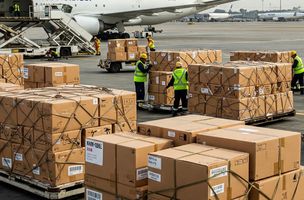
Cross-border eCommerce is booming and offers plenty of opportunities for online businesses to grow. But before diving into new markets, it’s essential to understand how cross-border shipping works and what to consider before selling your products overseas.
Going global is an important next step for eCommerce SMEs that wish to sell more, grow revenue and expand their horizons.
To help you make the leap into international markets we’ve covered everything you need to know to get started.
Who is this guide for?
Looking to unlock international growth? This guide is for small-and-medium sized eCommerce business leaders that want to know how to send a parcel abroad and where to begin. You’ll learn more about the signals that might indicate you’re ready for overseas expansion and discover the nuances of international parcel delivery vs domestic delivery.
From the basics to helpful tips and real-life success stories, you’ll be on your way to ensuring your international shipping is smart and seamless.
Let’s go!
In this guide we cover:
- What is Cross-Border Shipping?
- Getting Started with Cross-Border Shipping
- Understanding Taxes, Duties and Customs
- How to Optimise Your Logistics for Cross-Border Delivery
- Spotlight on Cross-Border Ecommerce Markets
- Real-life Examples of Cross-Border Shipping Success
- Essential Resources for Ecommerce SMEs
What is Cross-Border Shipping?
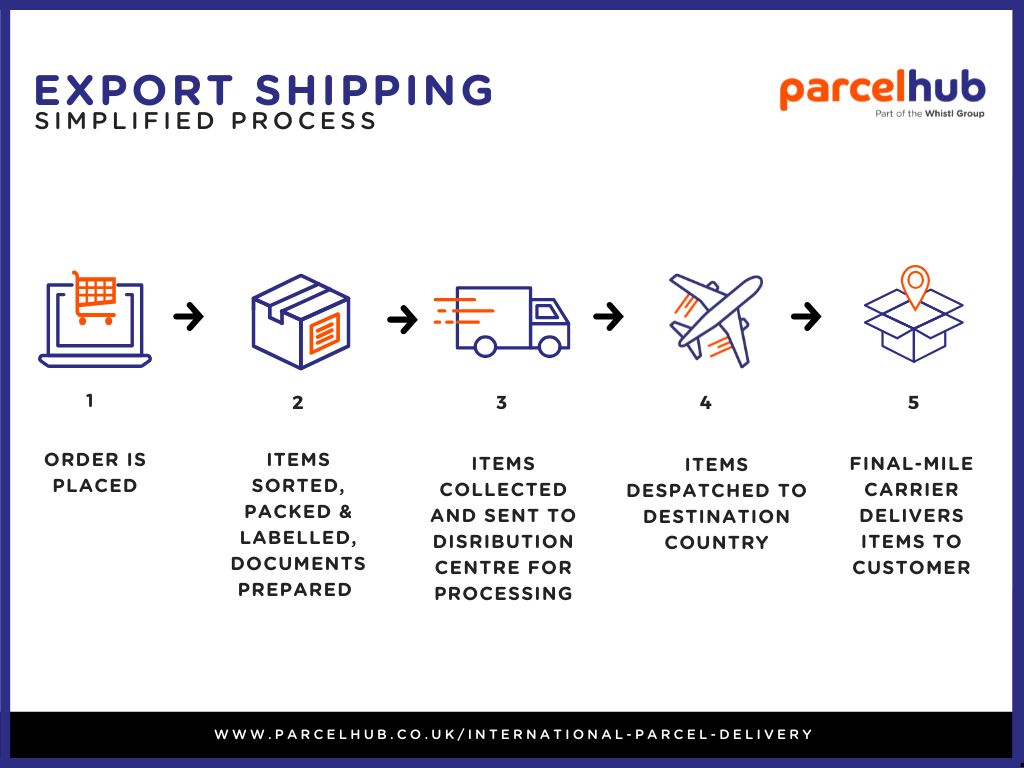
Put simply, cross-border shipping refers to sending eCommerce products directly to international customers without relying on local warehouses or distribution centres (however, we’ll touch on this). This involves various transportation methods, such as road, rail, sea, or air.
While similar to domestic delivery, there’s one big difference.
Sending parcels overseas requires additional steps like paying local taxes and preparing necessary documentation, as each country has its own import rules and tariffs.
Although these complexities can be off-putting, modern technology and reliable shipping partners simplify the process.
With the right strategy, preparation and partnerships in place, your eCommerce store can start thriving on a global scale.
The Growth of Cross-Border Ecommerce
According to research published by Statista, the global B2C cross-border e-commerce market is expected to reach a value of $7.9 trillion by the year 2030. This would represent a massive jump from $785 billion at the start of the decade.
Meanwhile, a 2023 study from Juniper Research found that cross-border eCommerce transaction values will rise by 107% over the next five years, outstripping domestic growth.
Which countries are at the forefront of this trend?
It may not come as a surprise to know that China is the world’s largest destination for cross-border shoppers. Online giants such as SHEIN and Temu have helped China hoover up 37% of the world’s cross-border online purchases, although Chinese eCommerce export growth is now declining.
Germany (13%) is next best, owing to its mature eCommerce market and interconnectedness with its European neighbours.
The United Kingdom (8%) is also well-represented, highlighting the global interest in UK brands and retailers.
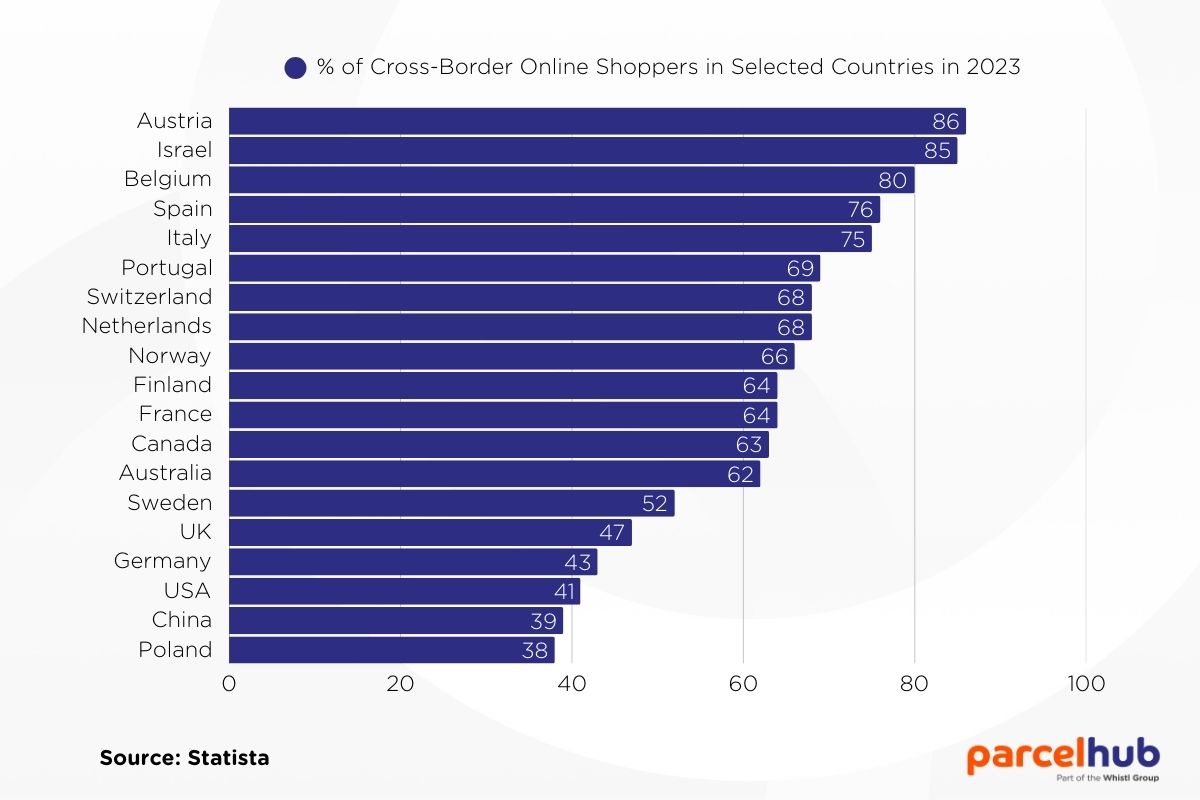
In terms of maturity, certain markets have emerged as being particularly predisposed to making cross-border purchases.
There are various reasons why this is the case. For example, higher levels of internet connectivity, country proximity and good trade relations all contribute towards creating trust amongst consumers. Inferior domestic products can also drive purchases from international destinations.
Austria (86%) and Israel (85%) top the list of countries with a high percentage of cross-border online shoppers, closely followed by Belgium (80%), Spain (76%) and Italy (75%).
Benefits of Cross-Border Shipping for Ecommerce SMEs
Whether you’re trading from a website, online marketplace or digital platform, you have access to potential customers across the globe. This provides a unique competitive advantage over UK-only shippers and bricks-and-mortar stores.
SMEs can benefit from cross-border eCommerce in the following ways:
- More revenue opportunities: Building your brand beyond your local market gives you access to a new customer base. By tapping into areas with high demand for your products you’re more likely to increase sales and strengthen your market position.
- Greater business resilience: Diversifying the number of countries you ship to ensures your business is not reliant on a single market. This is particularly important for eCommerce stores operating in a highly competitive domestic space or those that are selling niche products within already crowded markets.
-
Bigger buying power: International growth can also provide eCommerce businesses with access to preferential rates and enhanced economies of scale from parcel carriers and delivery management partners like Parcelhub - part of the Whistl Group. Bigger and more consistent international volumes will make you an attractive customer and boost your bargaining potential, resulting in lower shipping costs and bigger profits.
Challenges and Considerations
International expansion has many benefits. But cross-border eCommerce does also involve certain considerations that will need to be addressed before making any moves.
- Establishing local presence: Online retail provides access to a global audience. But each region or country will have its own nuances. You may need to adjust your product range, selling platform and advertising strategy, accordingly, taking into account cultural and language differences. Consulting with country experts can be invaluable and help accelerate your global growth.
-
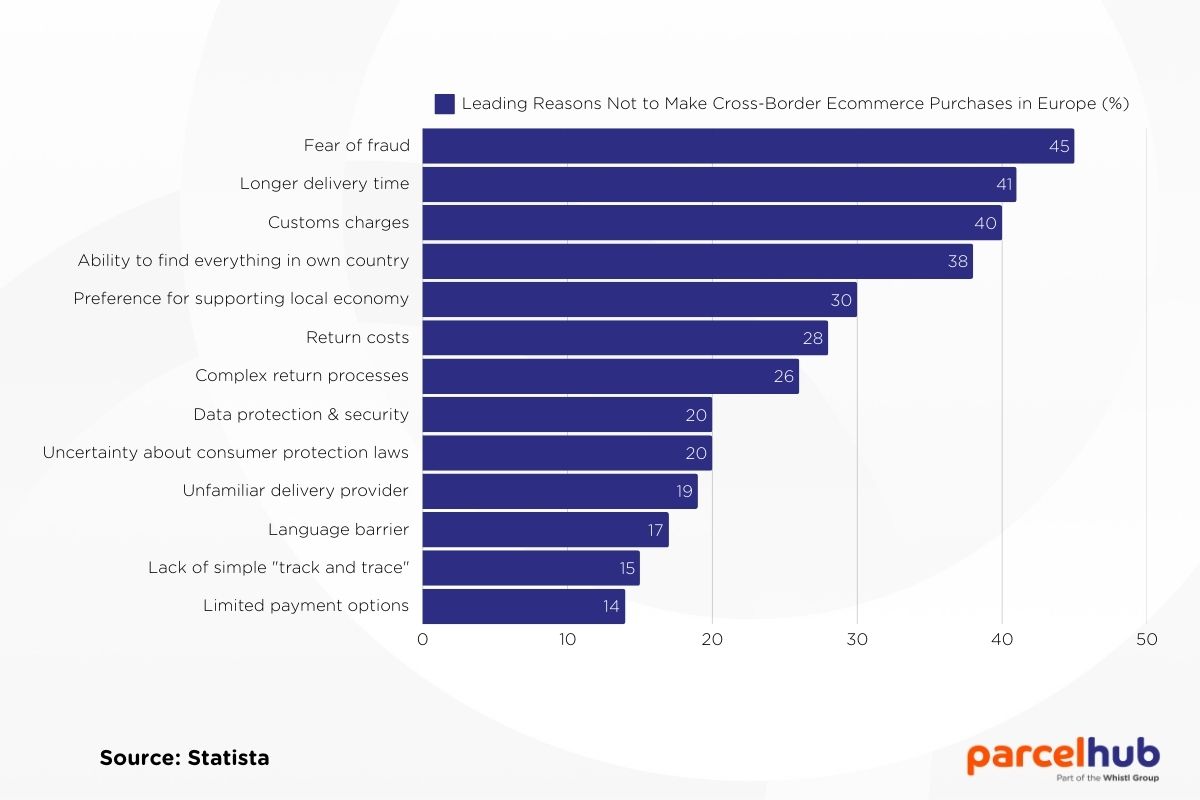
Building trust: Issues related to trust and reliability are often cited as the biggest barriers to cross-border trade. According to a 2023 European online shopper survey, fear of fraud (45% of respondents), longer delivery times (41%), and custom charges (40%) were the leading reasons not to make cross-border eCommerce purchases. It’s vital to openly communicate any information related to delivery times and costs, as well as ensure you have adequate delivery options and security protocols in place.
-
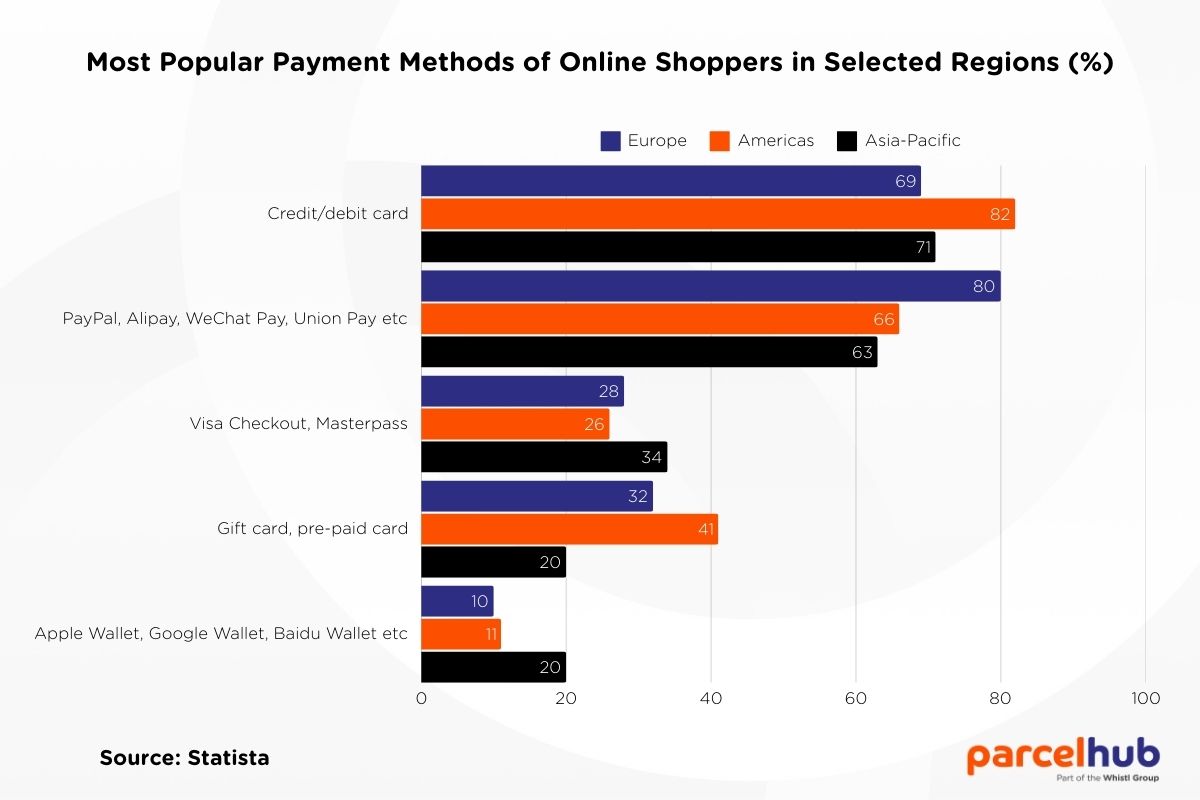
Managing payments and different currencies: Dealing with multiple foreign currencies, transaction fees and cross-border payment methods is another important aspect of international shipping. Technology and software providers offer essential tools to help manage these processes. But it’s worth building some understanding of country-by-country preferences. For example, credit card is the preferred payment method for 24% of UK online shoppers. However, this figure is just 9% for online purchases made in Germany, with PayPal the most popular option.
-
Taxes, Duties and Compliance: This is perhaps the most challenging issue for both retailers and customers. Firstly, you need to check international export embargo lists (a limited number of countries will not accept inbound traffic) as well as rules on restricted items as these can differ greatly across items and countries. We’ve got a whole section on taxes, duties and customs later in this guide.
Exploring New Markets? Speak to a Cross-Border Shipping Expert
Getting Started with Cross-Border Shipping
So, you’re ready to go global? Let’s break down the key steps to get you started with shipping internationally.
Do Your Market Research
First up – market research. Because you need to understand your potential international consumers and know where your products might sell well. Here's how to get started:
- Look at your website analytics. Are you getting visitors from certain countries? Are there any spikes from specific countries around key global or local holidays?
- Check out online marketplaces like Amazon or eBay. See if products like yours are popular in other countries.
- Use tools like Google Trends to see what people are searching for in different parts of the world.
Remember, just because a product is hot in your country doesn't mean it'll be a hit everywhere.
Establish Your Market Fit
Once you've identified potential markets, it's time to see if your products are a good fit. Ask yourself:
- Is there a need for your product in this market?
- Are there any cultural considerations? (For example, certain colours or symbols might have different meanings in other cultures.)
- What's the competition like? Are there local businesses offering similar products? Are they already well-established?
- Can I sell to my target market? Always check local restrictions as the size, weight and type of product(s) you sell may be prohibited.
Your job is to find the sweet spot where your product meets a need in the new market.
Positioning and Localisation
Now that you know where you want to sell, it's time to adapt your approach:
- Translate your product descriptions and website. But don't just use Google Translate – get a native speaker to help ensure it sounds natural.
- Adjust your marketing messages to resonate with the local culture. Effective localisation is more than simply adapting language, currency and pricing.
- Consider local holidays and shopping seasons. For example, Black Friday might be huge in the U.S, but Singles Day is the world’s biggest sales event and expanding beyond Chinese borders.
Shifting products is the aim but your brand is the star attraction. The way you position your brand must feel natural, authentic and trustworthy to your potential new customers.
Managing Currencies and Payments
Juggling multiple currencies can get tricky. Here’s what to consider:
- Decide which currencies you'll accept. Having plenty of options is great for customers but can add more complexity for you.
- Look into services and tools that can handle multiple currencies and give you good exchange rates.
- Offer payment methods popular in your target countries. Digital wallet payment providers enjoy 50% of global market share and are particularly popular in Europe. However, credit and debit cards remain the most popular payment method in the U.S.
Choosing a Cross-Border Shipping Partner
Last but definitely not least, you need a reliable way to get your products to your international customers. Here's what to look for in a cross-border shipping partner:
- Experience with cross-border shipping to your target countries.
- Competitive rates (remember, shipping costs can make or break international sales).
- Good tracking systems so you and your customers can follow packages.
- Ability to handle customs paperwork (this is a big help).
Don't be afraid to shop around and compare different global shipping companies. A good partner can make your cross-border shipping journey much smoother and will be prepared with answers to your frequently asked questions.
Getting started with cross-border shipping might seem like a lot, but take it step by step. Do your research, prepare well, and soon you'll be selling to customers around the world!
Understanding Taxes, Duties and Customs
Getting to grips with customs duties, taxes and regulations is often one of the biggest stumbling blocks for eCommerce SMEs. This is especially true in today’s heated global environment where international trade wars, including the China-U.S escalation, threaten to derail key cross-border routes.
Here’s a beginner’s guide to understanding taxes, duties and customs when exporting from the UK.

Customs Duties and Taxes
Let’s start with the basics. Cross-border eCommerce involves a lot of International Commercial Terms (Incoterms) that can be tricky to get to get your head around.
And then there’s a whole bunch of other acronyms to contend with.
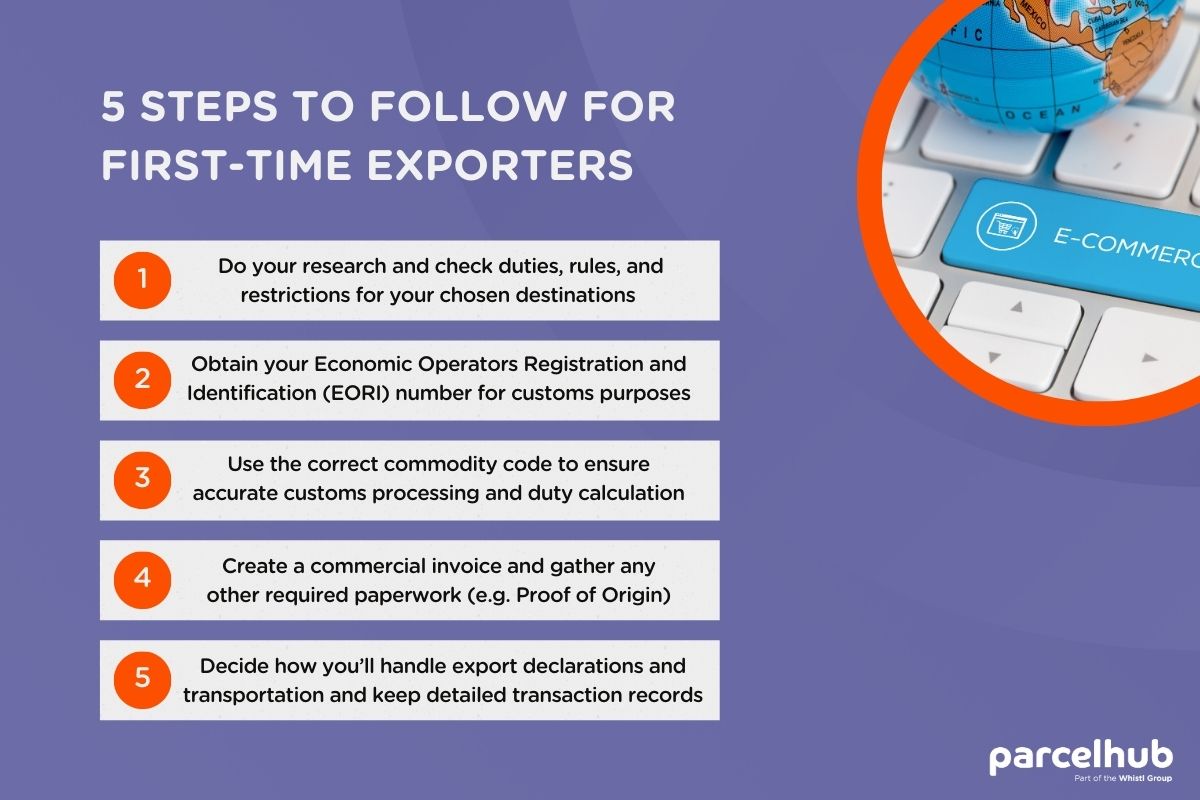
You might be wondering: what’s the IOSS? How do I fill in a customs declaration form? Which HS Code should I use?
Ultimately, when exporting goods, you’re going to encounter customs duties or taxes levied by overseas authorities. Often these are imposed to generate revenue and protect domestic industries. But in some cases they’re used as an economic mechanism to influence spending behaviours or to help manage export-import trade balances.
Put simply, duties and taxes are an inevitable part of cross-border selling.
Rates vary based on different factors, including:
- Product category
- Value of goods
- Country of origin
- Whether the UK has any existing trade agreements with the destination country. This can lower or eliminate duties.
The UK Trade Tariff is a useful tool for finding the correct commodity code you should be using and for calculating duties and taxes.
To calculate duties, start by finding the HS code of your product. Then, add up the value of the value of the goods, freight costs, insurance and any additional costs before multiplying the total by the duty rate.
Sales tax or VAT is calculated by adding together all your costs and the duty. Then multiply this by the rate of VAT for your product type in the country you are exporting to.
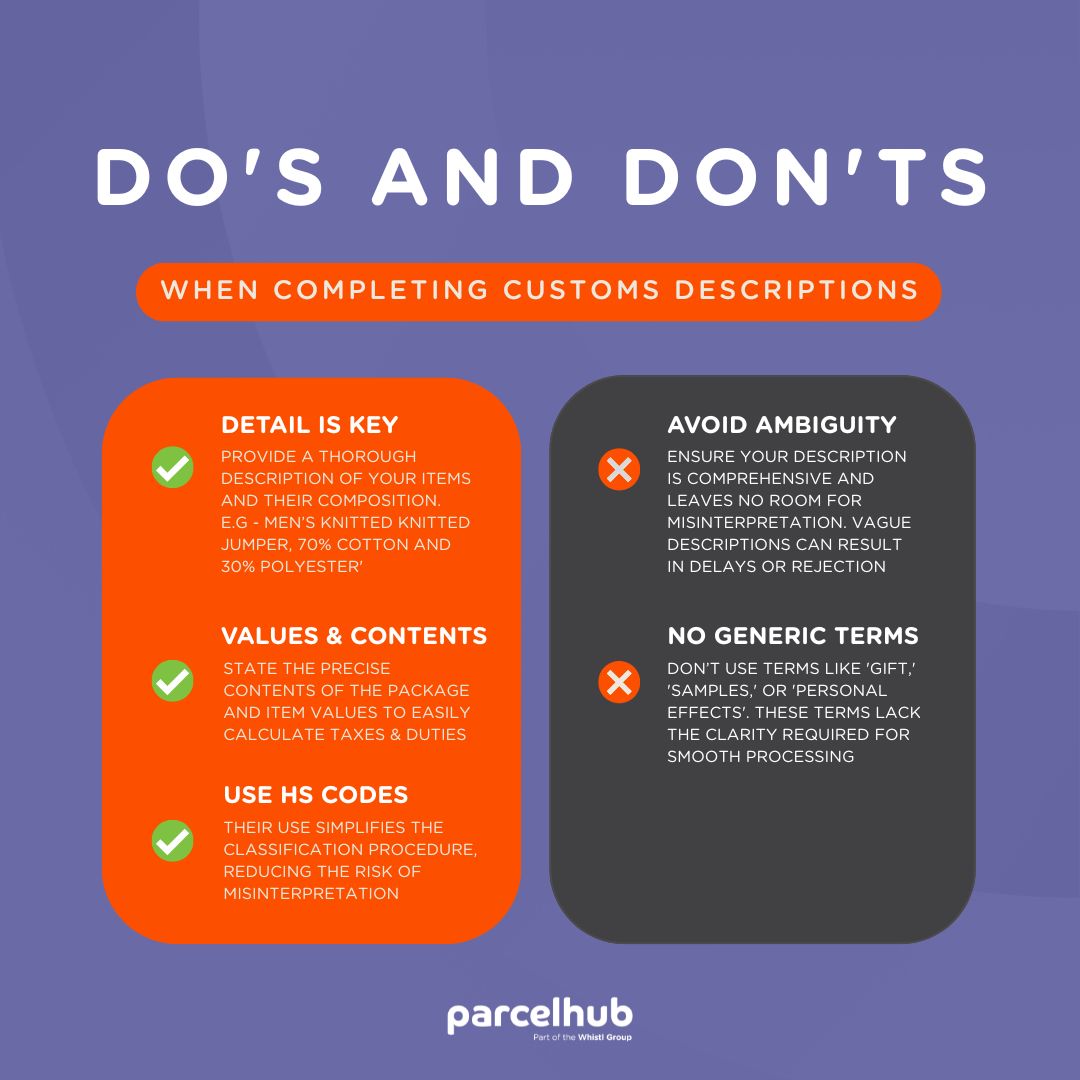
To ensure you pay the correct amounts it’s essential to use complete product descriptions and accurate HS (Harmonised System) codes.
Incoterms
International Commercial Terms (Incoterms) clarify responsibilities for costs and risks between buyers and sellers. It’s important you know which terms you’ll be adhering to when selling and moving goods overseas There are 11 internationally recognised terms in total.
Key terms include:
- CIF (Cost, Insurance and Freight): This stipulates the seller’s charges to cover the expenses, insurance, and freight of the buyer’s order while the goods are in transit.
- DAF (Delivered at Frontier): This refers to where the seller delivers goods to a specified frontier ready for unloading. The seller is responsible for covering costs and risks up to this point, while the buyer takes responsibility for import customs clearance, duties, and further transportation.
- DDP (Delivery Duty Paid): Seller covers all costs and risks, including duties.
- DAP/DDU (Delivery at Place/Delivery Duty Unpaid): Seller handles delivery, but buyer pays import duties and taxes.
- FOB (Free on Board): This states that the seller is responsible for delivering goods onto a vessel at the shipment port. From this point onward, the buyer takes on all the risks and costs of goods.
Important Identifiers and Systems
The following list covers some of the most important identifiers and systems you’ll need to be aware of.
These are:
- EORI Numbers: Any seller based in Great Britain or Northern Ireland will need to register for an EORI number if exporting to the European Union. An Economic Operators Registration and Identification (EORI) number enables customs authorities to identify who is responsible for the goods being transported.
- HS Codes: The Harmonized System (HS) Code system is used by international authorities to classify products, apply customs duties, and collect relevant trade information on imports. When shipping internationally, you’ll need to use HS codes to ensure your products can be properly identified. HM Revenue & Customs provides advice on how to find the correct commodity code before shipping.
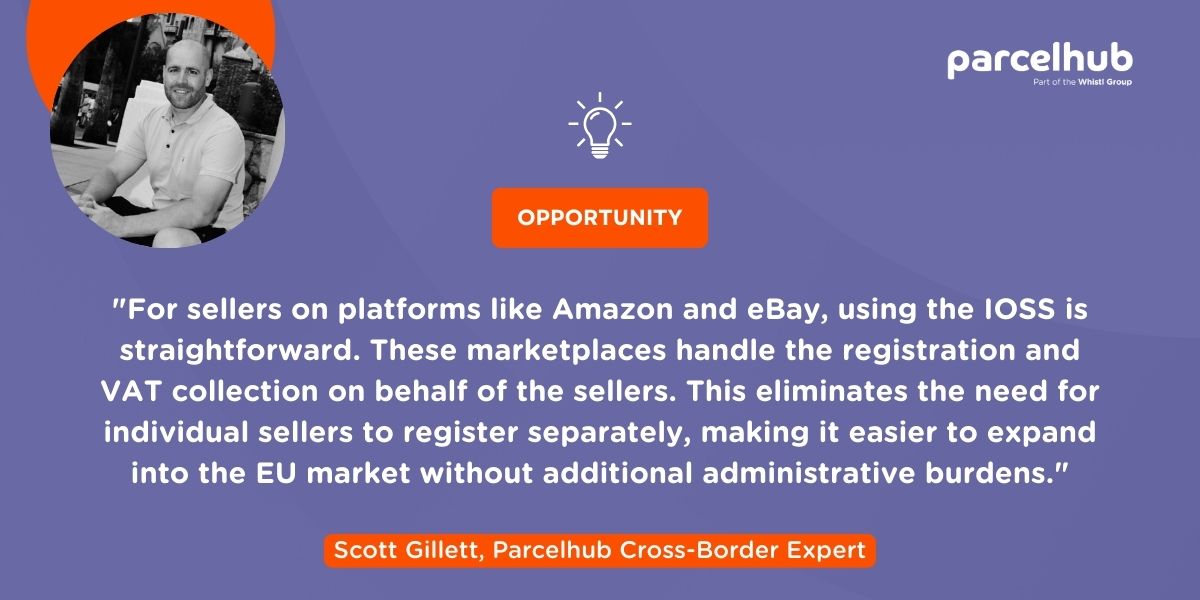
- IOSS: The Import One-Stop Shop (IOSS) has been set-up to streamline the collection of VAT and duties when shipping to the EU. Rather than having to register with multiple tax authorities across different member states, the IOSS facilitates one monthly VAT return to ensure correct payments are made. The IOSS only applies to eCommerce sellers based in Great Britain (or other third countries) sending goods with a consignment value that does not exceed €150. Speaking to a Whistl Cross-Border Solutions expert can help you better understand the IOSS and ensure you follow the correct procedures.
Key Considerations
- Cross-Border Taxation: Understand VAT, sales tax, and customs duties in each market.
- Currency Fluctuations: Monitor exchange rates to maintain profitability.
- Trade Restrictions: Be aware of quotas or restrictions on certain goods.
- Data Privacy: Comply with data protection regulations in all operating countries.
Best Practices
- Research destination country regulations thoroughly and stay in the know on regulation changes.
- Partner with experienced customs brokers or logistics providers.
- Implement technology solutions for automated customs and tax compliance. Partners such as Avalara and Hurricane Commerce can be invaluable.
- Regularly train staff on international shipping procedures.
- Consider using the IOSS for EU shipments to streamline VAT collection.
- Keep detailed records of all international transactions.
- Clearly communicate potential additional costs to customers to avoid surprises.
By understanding these key aspects of cross-border shipping, eCommerce SMEs can reduce delays and ensure compliance in their international operations.
How to Optimise Your Logistics for Cross-Border Delivery
Selling internationally is exciting. But sending products worldwide can feel overwhelming in the early stages. Here’s how to simplify your cross-border logistics and keep customers happy:
1. Choose the Right Delivery Options
Give customers choices that fit their needs and budgets:
- Express shipping: Fastest option (typically 2–4 days), perfect for urgent orders.
- Tracked shipping: Full visibility from warehouse to doorstep (typically 4–6 days when sending to the EU, 5-8 days for the rest of the world).
- Untracked shipping: Best for budget-friendly orders but does not offer the same visibility (typically 3-6 days to the EU, 5-10 days for the rest of the world).
Why it matters: Offering options helps customers pick what works best for them. Pair this with clear delivery timelines upfront—no one likes surprises!
2. Know What You Can’t Ship
Every country has rules about prohibited items. For example:
- Australia bans vitamins/supplements without approval.
- Norway restricts alcohol imports.
- Many countries block plant-based products.
Pro Tips:
- Check your target country’s customs website before listing products.
- Work with a multi-carrier shipping partner that will be able to offer greater choice and flag restricted items.
3. Balance Costs and Pricing
Stay on top of your cross-border shipping costs. Here’s how to remain competitive:
- Calculate “landed costs”: Product price + shipping + taxes/duties.
- Offer flat-rate shipping for simplicity (e.g, £10 worldwide).
- Use bulk discounts with carriers for frequent shipments.
Pro tip: Be upfront about potential duties. Use tools that show customers these costs at checkout to avoid any shocks.
4. Prioritise Customer Experience
Happy customers = repeat buyers. Nail these basics:
- Tracking: Send automated updates (e.g., “Your order cleared customs!”).
- Easy returns: Partner with a delivery management partner that can provide international returns.
- Multilingual support: Translate FAQs or use chatbots for common questions.
Example:
“Your order is on the way! Track it here: [link]. Need help? Reply to this email in English, French, or German.”
5. Level Up Your Fulfilment
Ready to grow? Improve delivery speed and costs with:
- Local warehouses: Store products closer to customers (cuts shipping time/costs).
- 3PL partners: Let experts handle packing, shipping, and returns.
- Inventory tools: Use software to predict demand and avoid stockouts.
Quick Checklist for Success
☑️ Offer 2–3 shipping speeds.
☑️ Double-check prohibited items.
☑️ Show total costs upfront.
☑️ Send tracking updates.
☑️ Plan for easy returns.
Test the resilience of your cross-border logistics in one country before expanding to the next destination.
Small, smart tweaks will ensure reliable delivery and keep your customers coming back for more.
Send parcels worldwide
with ease
International parcel delivery to over 220 countries and territories
Spotlight on Cross-Border Ecommerce Markets
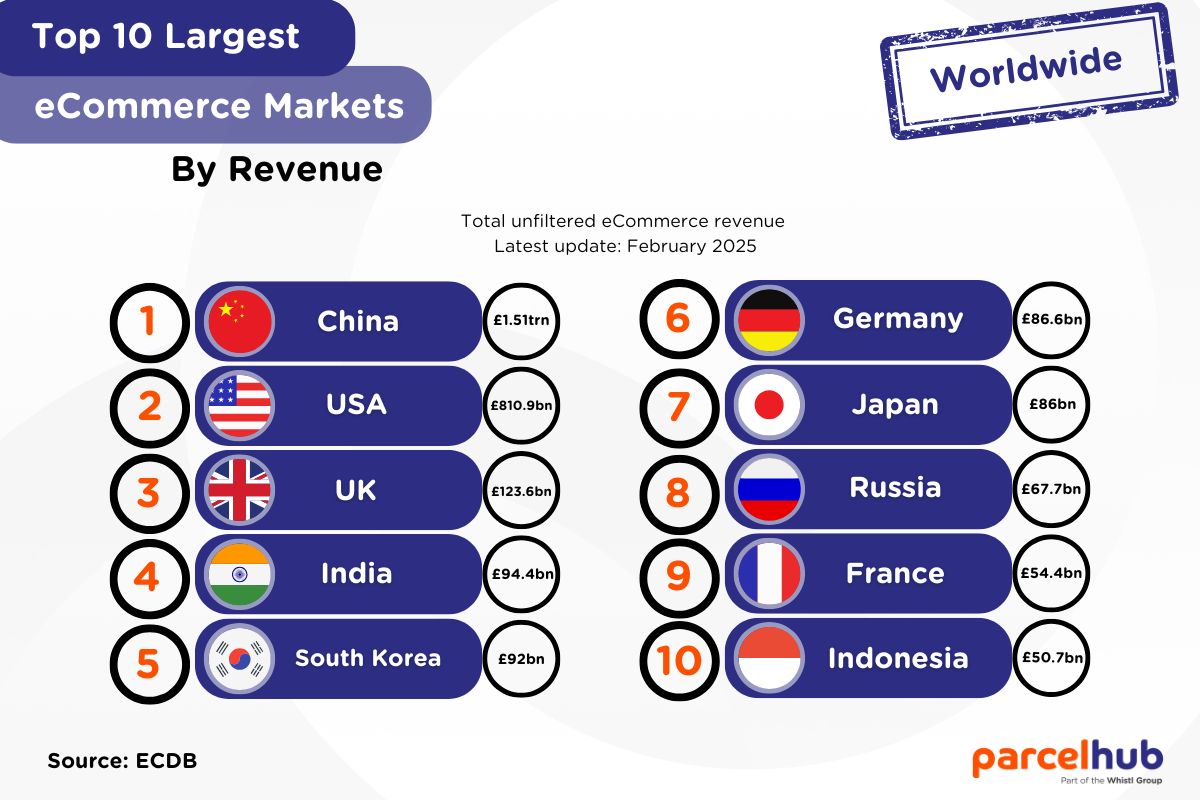
Data from ECDB highlights the trends shaping the cross-border landscape. Ecommerce growth is a consistent feature across the globe. But which markets show the greatest potential and what trends should you keep an eye on?
Top countries by revenue
The ‘big three’ eCommerce markets each experienced growth in 2024. China (£1.51trn in revenue) is the undisputed number one, ahead of the United States (£810.9bn) and the United Kingdom (£123.6bn).
Meanwhile, India (£94.4bn) has shot up the top 10 revenue list, overtaking South Korea (£92bn), Germany (£86.6bn) and Japan (£86bn).
Top countries by growth rate
Measuring country movements by their percentage growth rate reveals some interesting trends.
For example, Germany was the only country in the world’s top 20 biggest markets to witness a decline (-0.3%) between 2023-2024.
Meanwhile, the United Kingdom’s modest 0.4% growth rate hints at potential market saturation and pressures. This arguably reinforces the point that UK-based eCommerce businesses should be looking overseas to reduce their dependency on domestic consumers.
By contrast, the surging Indian market posted 17% growth. Elsewhere, Turkey (11.4%), Mexico (23.4%), Thailand (19.2%), Vietnam (13.3%) and the Philippines (17.2%) were other emerging markets to record double-digit percentage growth.
Top countries by online share
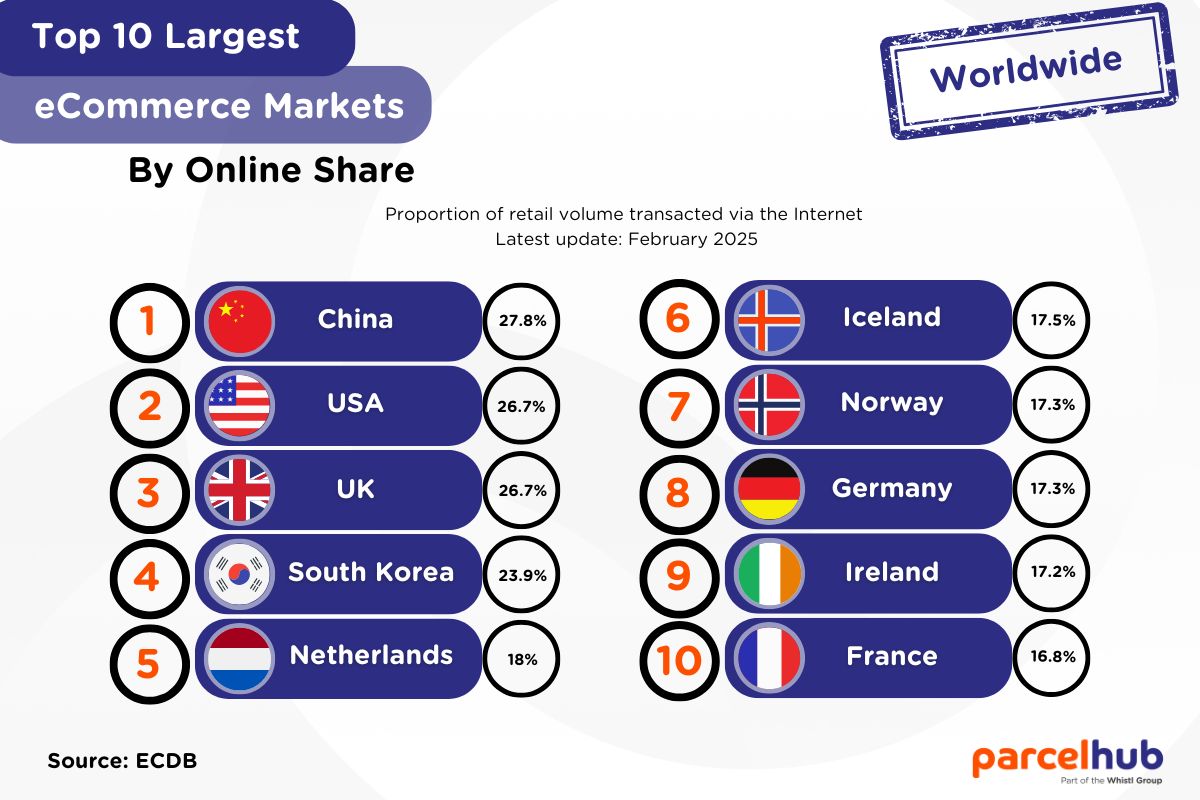
It’s no surprise to find that the world’s biggest markets each have a high online share of retail revenue.
Again, China (27.8%), the United States and United Kingdom (both 26.7%) lead the way.
However, despite high total eCommerce revenue, the online share in India (4%) and Indonesia (9.4%) is relatively low. This hints that there remains untapped potential in those markets.
Other countries with maturing markets, increasing revenue and room for further growth include Singapore (8.9% growth, 16.8% online share) and Australia (6.8% growth, 16.2% online share).
Top 10 UK Export Markets
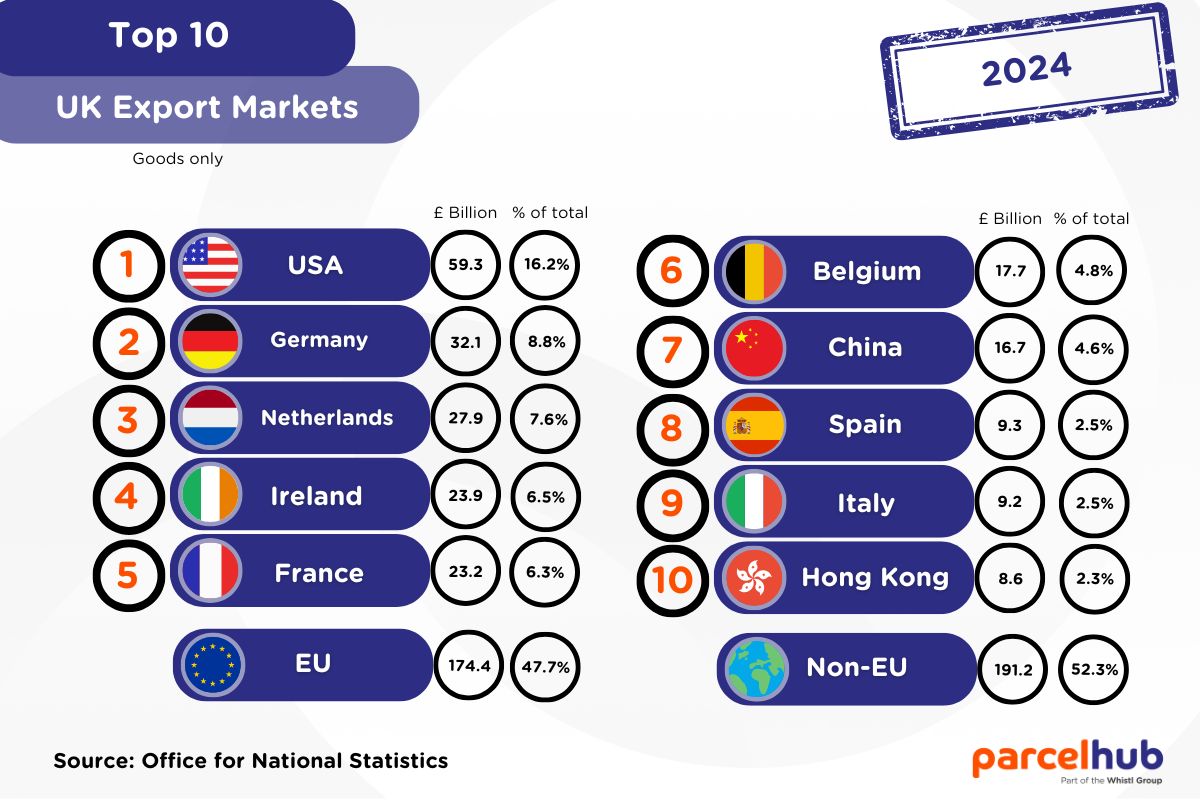
The list of the UK’s top export partners (goods only) has remained relatively stable in recent years with the United States, Germany and Netherlands leading the way.
It is not yet clear how tariffs imposed by the United States government will affect UK exports to its top destination. While there are legitimate concerns, it seems unlikely that any other country will replace the U.S as the leading export partner in the immediate future.
Overall, Non-EU exports lead the way, despite seven of the top 10 countries being members of the EU trading bloc.
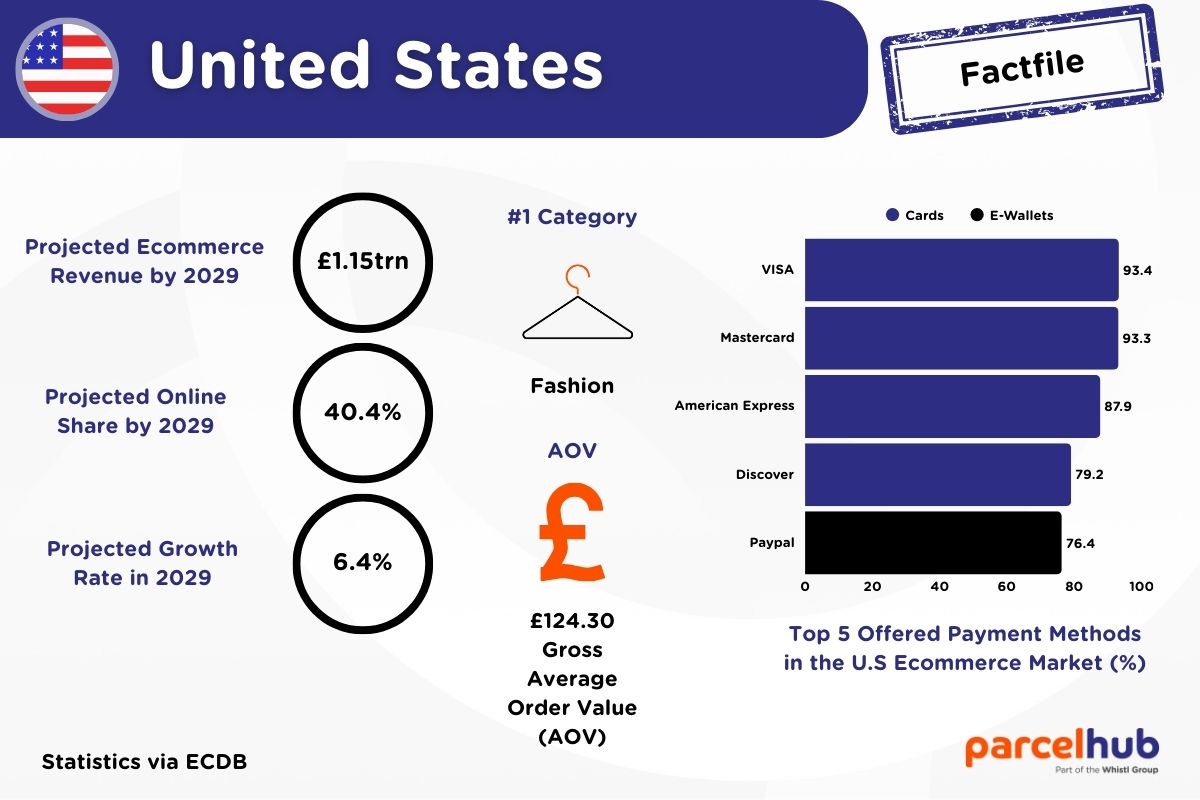
Spotlight on the United States
The United States is the UK’s largest export market, accounting for over 20% of total exports worth £182.1bn for the four quarters to the end of Q3 2024.
The U.S remains a natural fit for expanding eCommerce SMEs. However, close attention needs to be paid to the ongoing ‘Trump Tariffs’ and their potential impact on UK goods arriving into the country.
Another factor to consider is the relatively high return rate compared to other mature eCommerce markets, and therefore your ability to manage returns from U.S consumers.
Key facts (based on 2024 figures)
- Add-to-cart rate: 12.1%
- Cart abandonment rate: 72.5%
- Conversion rate: 3.3%
- Return rate: 11.7%
Spotlight on Ireland
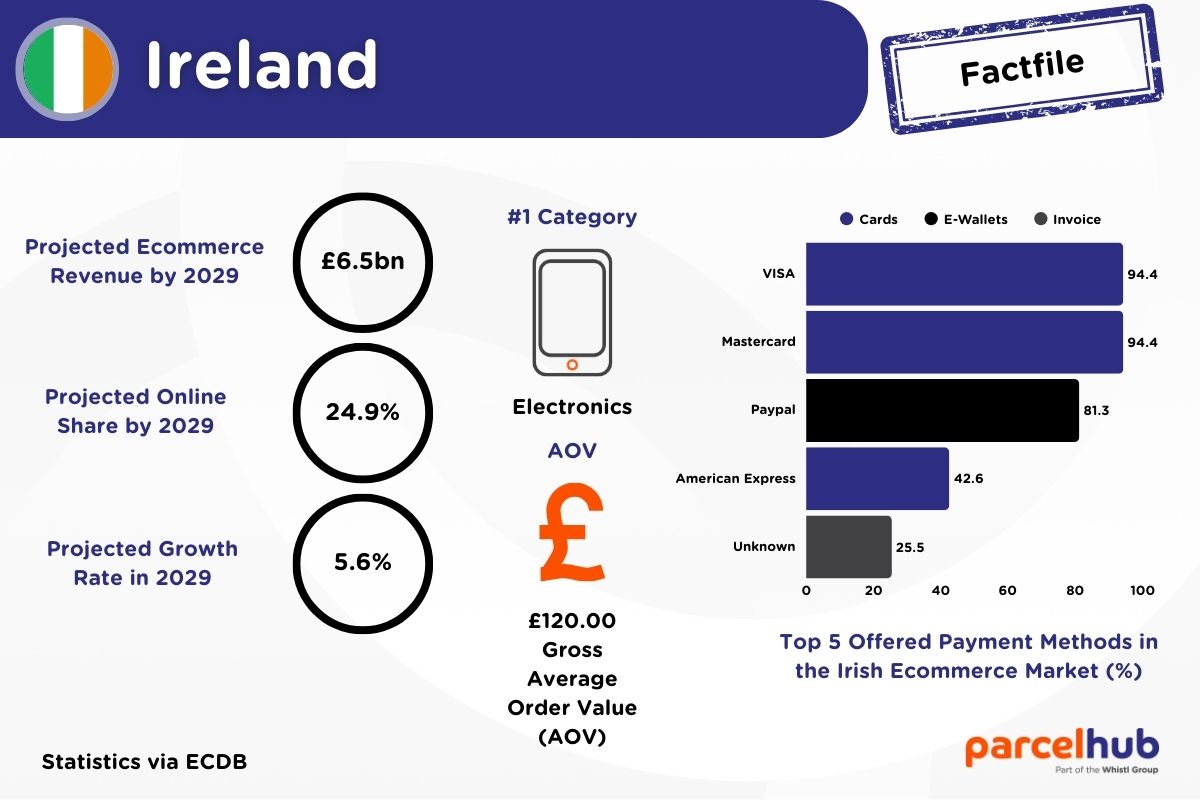
The Republic of Ireland represents one of the UK’s closest partners, both geographically and in terms of trade.
Ireland ranked fourth in the list of countries the UK exported goods to in 2024 (£23.9bn). Amazon.co.uk is the top destination amongst Irish online shoppers.
Key facts (based on 2024 figures)
- Add-to-cart rate: 10.3%
- Cart abandonment rate: 72.8%
- Conversion rate: 2.8%
- Return rate: 6.9%
Spotlight on France
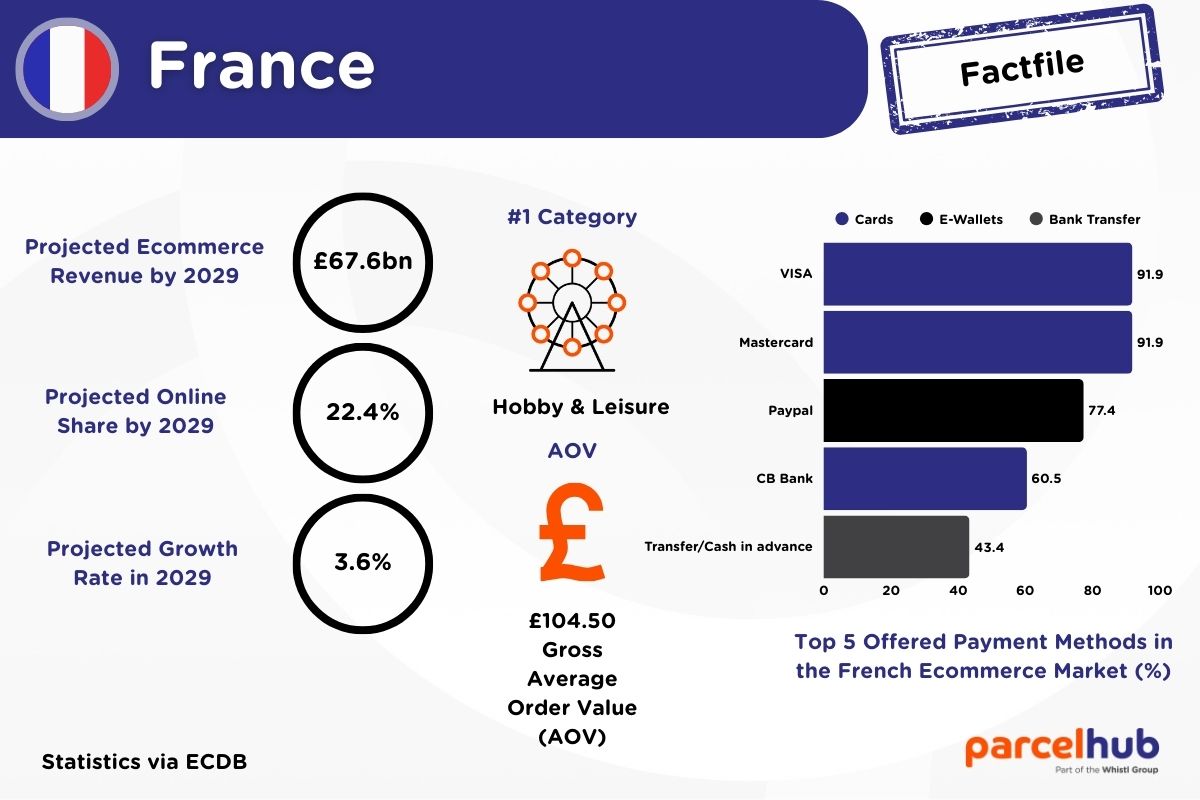
France is another country in easy reach to UK businesses. It is the fifth largest UK export market (£46.1bn) and boasts a sophisticated eCommerce and logistics network.
While overall market growth is below the global average, there has been a recovery from 2022’s sharp -9.7% slump.
Hobby & Leisure, Furniture & Homeware, and Care Products are some of the biggest categories projected to see further growth.
Key facts (based on 2024 figures)
- Add-to-cart rate: 11.7%
- Cart abandonment rate: 71.8%
- Conversion rate: 3.3%
- Return rate: 6.9%
Spotlight on Germany
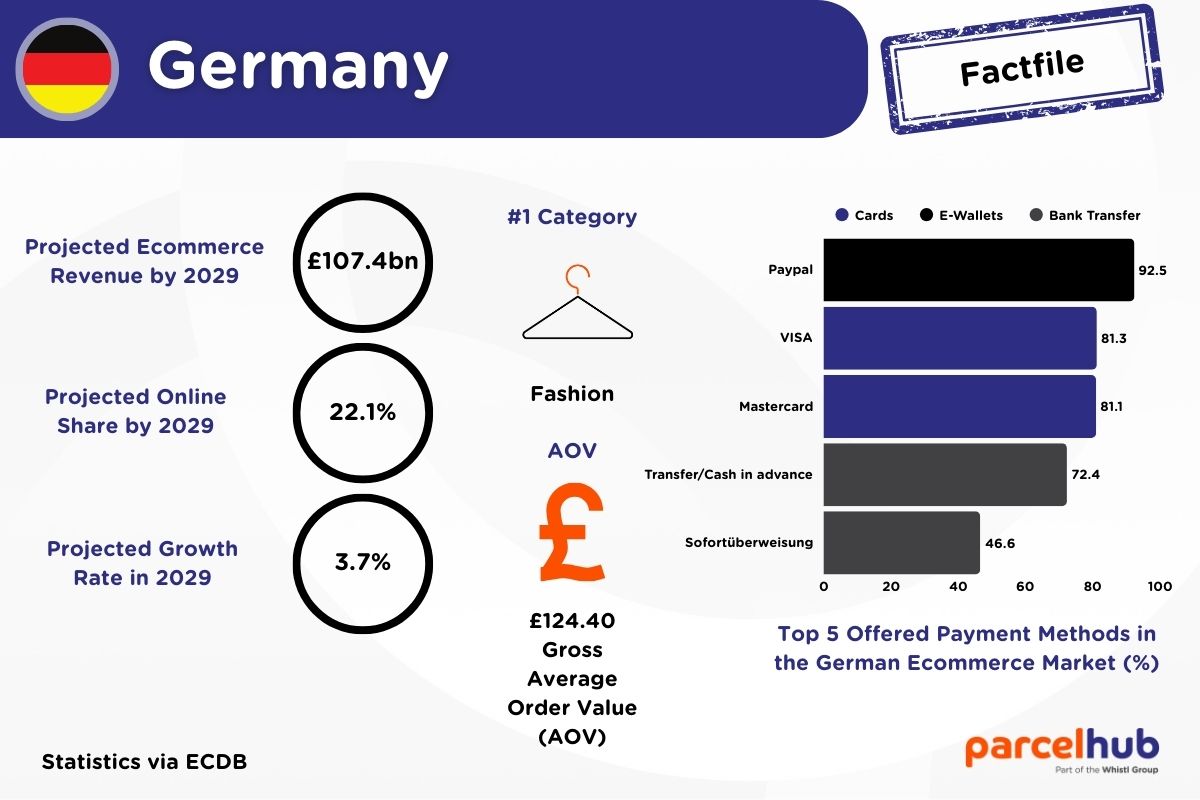
Germany is the second largest UK export market (£59.5bn) and remains a strong and stable economic partner in the heart of Europe.
The German eCommerce market witnessed a slight decline in 2024. But the Average Order Value (AOV) remains high (£105.20 net) and conversion rates are holding up well compared to other countries.
Key facts (based on 2024 figures)
- Add-to-cart rate: 9.5%
- Cart abandonment rate: 65.7%
- Conversion rate: 3.3%
- Return rate: 9.2%
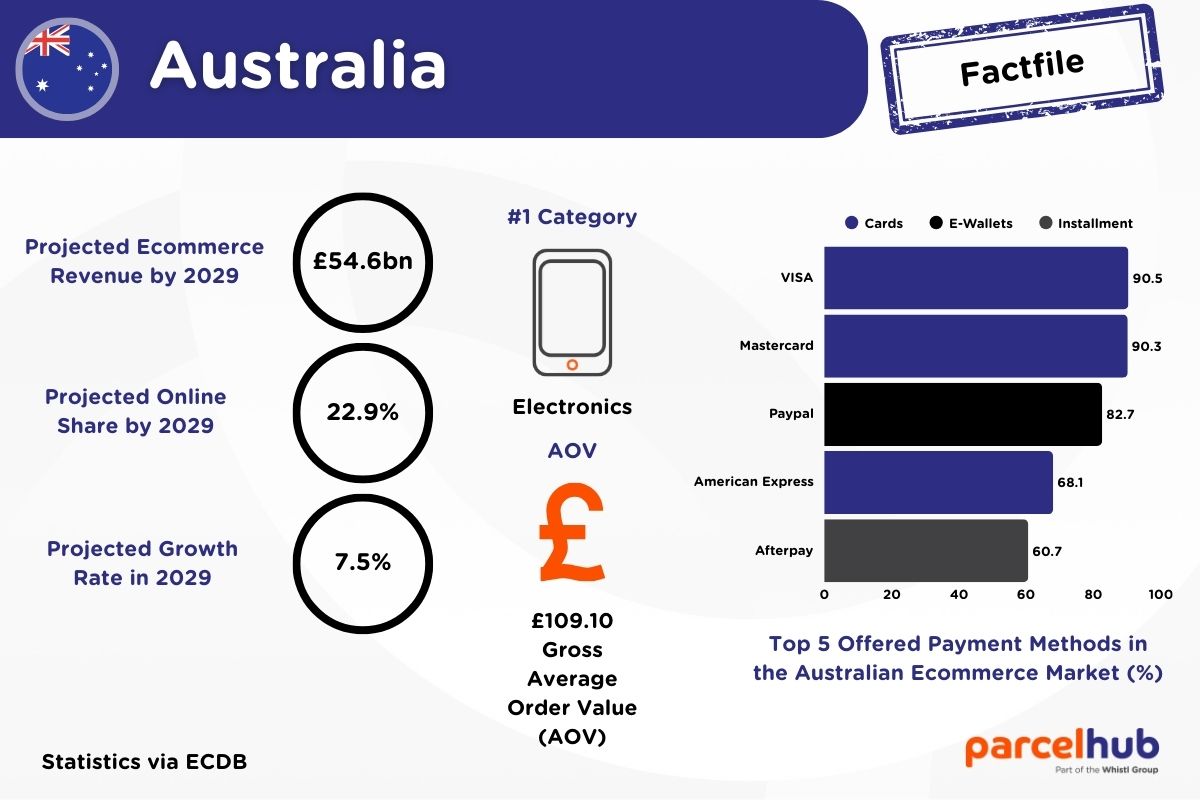
Spotlight on Australia
Non-EU markets have grown in importance since the UK decided to leave the European Union in 2016. As a result, Australia has seen a steady influx of UK goods and services, with steady export growth reaching £14.8bn in 2023.
Historic and cultural ties, alongside favourable free trade agreements, make Australia an attractive destination.
Key facts (based on 2024 figures)
- Add-to-cart rate: 9.1%
- Cart abandonment rate: 62.6%
- Conversion rate: 3.4%
- Return rate: 8.9%
Real-life Example of Cross-Border Shipping Success
We provide smart and integrated cross-border solutions combined with hands-on support that makes it easy to grow internationally.
Here’s how we’ve helped eCommerce SMEs expand across borders and enhance their international shipping.
Canadian beauty product distributor Living Beauty Inc. was facing long transportation times and issues with damaged shipments. Since the start of our partnership, transportation times have shortened by 50% compared to the previous one-two week timeframe, due to more efficient cross-border shipping and customs clearance. Meanwhile, seamless integration into Living Beauty Inc’s existing systems allowed us to make rapid improvements to their cross-border delivery strategy.

Essential Resources for Ecommerce SMEs
UK Government Guide to Exporting
Department for Business & Trade: Learn to Export
Department for Business & Trade: International Markets Tool
Choose Which Incoterms are Right for You
European Free Trade Association
Grow Globally with Smart and Integrated Solutions from Parcelhub
Want advice on which new markets to enter? Need access to faster and more visible tracked parcel delivery?
We can help you expand into new markets with international shipping to and from the UK. You’ll get access to preferential shipping rates, multiple carrier options to over 220 countries and territories, and be guided by a dedicated account manager. Speak to our experts to discuss the best options for your business.
For more eCommerce inspiration, check out our latest news and insights.
Share this article
You may also like...