For growing eCommerce businesses, one of the most promising avenues is understanding how to find and then attract international customers. While your products are bound to have audiences in other countries, it is important to take into account how different cultures and values can impact perspectives on a product, especially one from an overseas retailer.
In this article, we will highlight the importance of getting international clients interested in your offering before providing some of our strategies for finding and attracting international customers to your business.
Why is it Important to Attract International Customers?
While there are many potential benefits to attracting international customers to your business, finding and fostering an international customer base is equally important to provide security to your business from unforeseen market changes. Here are some of the benefits and reassurances that international customers can offer your business:
Increased Revenue and Growth
More customers typically equate to more sales and increased revenue. Therefore, by expanding your consumer base to include international customers, you can make more money and grow your business faster.
Expanding into New Markets
As your business gains popularity in other countries, you may wish to establish a foreign base in countries with loyal consumer bases. By increasing your proximity with your international customers, you can gain valuable insights into more niche audiences, while positioning your business to expand into neighbouring countries.
Safeguarding Against the Local Economy
Depending on the state of your local economy, you may find that sales from your local consumer base temporarily decrease. This can cause significant problems for businesses that rely on local customers, forcing them to neglect growth targets or downsize to survive. By attracting international customers to your business, you can protect yourself from challenges in your local market, maintaining a consistent revenue stream through international sales.
Strategies to Attract International Customers
While offering international shipping is a good place to start, there are many more steps you need to take in order to attract international customers to your business.
Here are some of the strategies that our clients employ to develop their international audiences:
Research Target Customers
While you may have an understanding of your local target audience, you cannot assume that the same marketing strategy will work to attract international customers, even if they have similar demographics.
From their language and culture to their online store and social media preferences, every country operates differently, and you would be wise to conduct thorough consumer research to understand what motivates their shopping habits.
Capitalise on Market Preferences
Once you have gained insight into your target customers, this information should inform how you market your product or services to them. While the proportion of cross-border eCommerce transactions has increased steadily since the COVID pandemic, it is important to remember that some nations prefer shopping domestically, while others love buying from abroad.
In its comparison of global and local brands, Statista found that many African and Asian countries preferred global products, whereas European and North American countries favoured local sources. While 77% of Nigerian consumers and 62% of Indians appear to value global brands above brands from their own countries, only 32% of the UK and 31% of the US would choose an international product over one produced in their own country.
With such insights, you can tailor how you market your business in one country to the next, improving your chances of attracting international customers. For instance, while you might choose to incorporate messaging about your product's origins to countries drawn to global brands, you would be better to emphasise any local partnerships you have made with countries that prefer locally sourced products.
In June 2020, Whistl conducted our own survey of 1000 consumers across the UK, the Republic of Ireland, France, Germany, Australia and the USA to improve our understanding of international online buying behaviour. For more insights from this survey, jump ahead to our section on why customers make international purchases.
Translate Content and Correspondence
It may come as no surprise that it is easier to attract international customers when your marketing is in a language they can understand. By translating your content, correspondence and any other brand assets into the native language of your target audience, you significantly increase the likelihood of international customers finding and interacting with your company.
While you could employ separate translators for each of your targeted companies, leveraging machine translation to automatically translate the text on your website and assets is often much faster and more cost-effective. As for correspondence, invoicing software allows you to convert the language and currency of your invoices to make sales easier to understand for international customers.
Localise Your Website
While translating your website is essential to ensure international customers can at least access your brand and products, localisation weaves additional cultural elements into your website to earn the trust of foreign audiences. From incorporating local dialects and references into your content to replacing images with subjects and icons that will resonate with your target audience, localising your website allows you to begin forming a relationship with your international consumer base.
But localisation is not bound to the frontend of your website. By implementing code snippets known as ‘hreflang tags’ on your website, search engines can identify which country and region your website is being viewed from, then direct users to the most appropriate version of your pages. The technical side of localisation also makes it possible to support popular payment methods in your target countries, as well as translate your keywords to compete directly with local businesses to attract international customers.
Leverage Social Media
Now that your website is optimised for your target audience, you need a strategy for how to get international customers to find your business in the first place. Assuming you have correctly conducted your consumer research, you should already know which social media sites your target audience prefers. Despite this, how you engage with customers on these sites is crucial to progressing them along your sales funnel.
Localising your social content to target specific regions and communities is an effective way to leverage social media to attract international customers to your business. Collaborating with local influencers can make this process more straightforward, as they can provide insight into local cultures and trends while placing your product in front of an already engaged online community.
Create Promotional Campaigns
Once you have found your foothold on social media, offering promotions can effectively get international customers interested in your brand. Exclusive discounts for new customers or bundling new products with reliable sellers is an intelligent way to broaden your reach with unfamiliar audiences, while providing free shipping on orders over a certain value is especially enticing for customers in other countries.
Provide Customer Services
As your business is likely to encounter more challenges with cross-border shipping than shipping to local customers, offering customer services to the countries you are targeting can be useful. Providing a channel for international customers to find information about their orders, register complaints, organise returns or simply ask questions about your products makes them feel valued. This is essential to building a loyal customer base.
Of course, to offer this solution not only requires customer service staff who are fluent in the languages of your international customers, but also are active outside normal business hours to accommodate different time zones. By partnering with a cross-border specialist like Parcelhub, you can outsource your customer service offerings to our dedicated team.
Provide Transparent Delivery Timeframes
Next-day delivery and delivery tracking options have increased consumer expectations for reliable and transparent delivery services. While cross-border shipments obviously cannot compete with the speed of local orders, customers still expect the same attention to detail from their international deliveries.
While only 3% of the participants in the Whistl survey claimed to have experienced difficulties when shopping from abroad, the only issue raised was that delivery took too long. This emphasises the importance of providing honest and realistic timeframes for delivery, as this manages your customers’ expectations while creating trust between them and your brand. Should any issues arise during transit that might delay your delivery, alerting consumers to the situation and providing them with updates is another way to strengthen your relationships, hopefully getting international customers to make repeat purchases.
Leverage Local Government Policies
While you need to account for regulations and international shipping fees specific to certain countries, many local governments enact various policies that you could use to attract international customers. For instance, the European Union (EU) has imposed GDPR data protection laws on all businesses selling to customers. Compliance with these laws allows you to advertise your high standards, earning the trust of international customers who can see that you value the privacy of their data.
Some local governments may offer incentives such as grants to businesses that operate or employ local people within their community. Earning one of these grants would not only give your business additional capital to invest in its growth but also give you insight and credibility with local communities.
Why Do Customers Make International Purchases?
Understanding what motivates consumers to purchase products from other countries is essential to developing strategies to attract international customers. From cultural factors impacting trust, to delivery options, product categories and marketplace preferences, international buying behaviour is influenced by numerous factors, which we observed as part of our survey.
The survey found that consumers mainly buy products abroad to save money (64%). The second biggest reason was to attain products not available in their home country (60%). The next biggest driver of cross-border shopping was consumers' desire to access unique products (51%), followed by international retailers offering free shipping (39%).
Where Do International Customers Make Their Purchases?
It may come as no surprise that China was the most popular destination for international consumers according to our survey, with five out of the six surveyed countries placing China in their top spot. The only outlier was the Republic of Ireland, whose consumers bought more from the UK than from China.
While the country offering goods has an impact on consumer behaviour, the sales channels that products are listed on are arguably even more influential. The Whistl study found that while Amazon dominated in France, Germany, and the UK (70%), it was significantly less popular (41%) in Australia, with Australian online shoppers preferring to buy on eBay (69%).
Beyond the scope of the Whistl survey, there are multiple other marketplaces to consider depending on the audience you are trying to target. In Africa, Jumia has taken the fight to Amazon, while Mercado Libre is the most popular marketplace in Latin America. From a global perspective, Chinese sites Taobao and Tmall overshadow eBay and Amazon in their popularity.
This disparity in marketplace preferences demonstrates the importance of understanding the international market you are targeting to attract international customers to your business.
What Are International Customers Purchasing?
There is no sense trying to find international customers in a country that shows no interest in your products. Considering which markets your products are likely to be popular in and which demographics your offering is likely to perform well with is crucial to avoid inadvertently wasting time on an incompatible audience.
The Whistl study found that clothing (64%) is the most popular item purchased by international customers, followed closely by electrical and telecoms goods (60%).
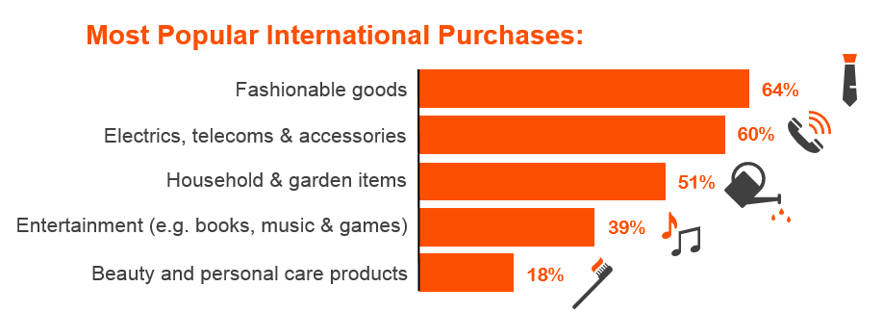
Of the respondents surveyed, men were more likely to buy electronics and sporting goods, whereas women tended to purchase more clothing, household goods, and beauty products. Buying behaviour also differed based on age profile, with almost two-thirds of those aged 18-39 buying clothing online, compared with only 46% of 60 to 79-year-olds.
With regards to global preferences, our survey produced the following findings:
- The Republic of Ireland buys more beauty and healthcare, clothing and entertainment products from overseas than any other country.
- French online shoppers purchased more telecoms and general electrical devices from overseas, but were more inclined to buy beauty and healthcare products domestically.
- American consumers bought fewer household and entertainment products from overseas.
What is the Future of International eCommerce?
At the time of the Whistl survey, the world was still battling the COVID pandemic, and the impact of Brexit was yet to be measured. As a result, when we asked respondents to predict how their international shopping habits would change in the next 12 months, many from the UK and mainland Europe posited that their spending would decrease in the years to come.
The reality has been quite different. Global eCommerce sales exceeded £3.55 trillion in 2020 and nearly reached £5 trillion in 2023. The shift ‘from west to east’ saw 1.4 billion people joining the world's middle class by the end of 2020, with most of them (85%) in the Asia Pacific region.
This bodes well for the future of international cross-border trade. Provided that you carefully monitor what consumers really want, drive continuous improvement, and evolve your offering to match international consumers’ demands, you will stand the best chance of maximising sales.
How Can Parcelhub Help to Attract International Customers?
At Parcelhub, we understand the benefits that international sales can offer eCommerce businesses. We’ve even developed numerous cross-border solutions to help our clients find their international customer bases. If you are keen to expand your business into a new market and would like to learn more about how to attract international customers, please contact us today. Our team can discuss how we can help you build your cross-border eCommerce strategy.
Share this article
You may also like...