Which Countries Boast the Highest eCommerce Industry Growth Markets?
October 2024
Want to learn more about how eCommerce industry growth is changing across the world? Online shopping has revolutionised how we purchase products and services, with B2C and B2B brands now reaching beyond their own borders to accelerate eCommerce growth.
However, while international eCommerce has exploded, some of the fastest-growing eCommerce markets in the world might surprise you.
In this article, we cover:
- The Rise of Cross-Border Shipping
- The Biggest Global Markets in eCommerce
- The Fastest-Growing eCommerce Markets in the World
- How to Benefit from International eCommerce Industry Growth
Before we get into the biggest movers, let’s first examine eCommerce market growth across the globe.
Growing eCommerce Industries: The Rise of Cross-Border Shipping
A continued increase in global internet penetration has enabled seamless cross-border shipping. By “cross-border”, we’re referring to the buying and selling of goods and services beyond domestic markets. Check out our international shipping terms glossary for more keywords.
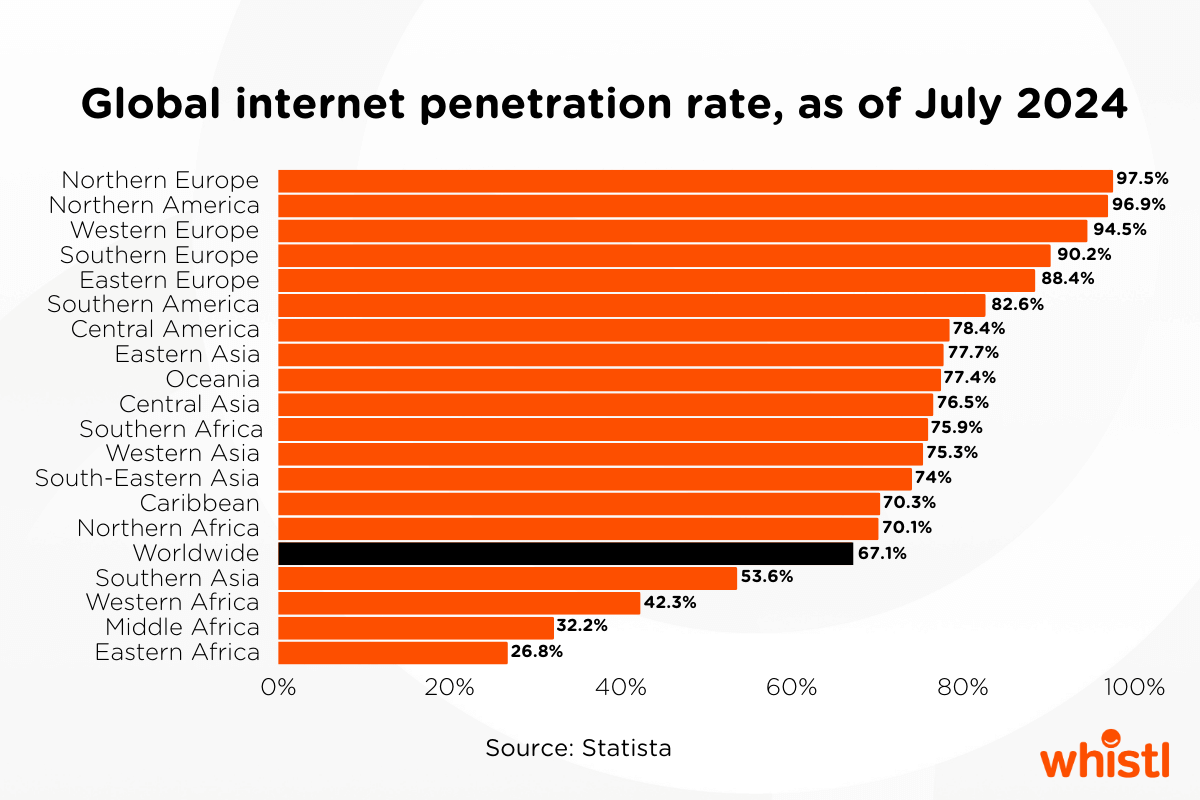
The worldwide internet penetration rate currently stands at 67.1%, with areas within Europe and North America benefitting from the highest connectivity. The European eCommerce market has previously broken records and shows no signs of slowing down.
However, other regions are catching up, with many of these home to the fastest-growing eCommerce markets.
Southern America (82.6%), which includes Argentina and Brazil, is rapidly enhancing connectivity. Mobile devices are playing a crucial role in this, with 4G network coverage estimated to be 94.17% in 2024.
Elsewhere, internet usage penetration in Southeast Asia is projected to rise to 90.58% by 2029. And while connectivity in the African continent lags behind the rest of the world, 75.9% of the population in southern Africa benefits from internet usage.
Naturally, a growing number of potential online shoppers has resulted in some promising commercial projections for both retailers and export shipping providers.
The global B2C cross-border market is predicted to reach a value of $7.9trn by 2030, up from $785bn at the start of the decade.
In summary, here are the key factors driving global eCommerce market growth:
- Globalisation: The interconnectedness of the world economy has made it easier for businesses to reach customers in new markets.
- Technological Advancements: The widespread availability of high-speed internet, mobile devices, and secure payment gateways has lowered the barriers to entry for online sellers and buyers.
- Changing Consumer Behaviour: Consumers are increasingly comfortable making purchases online, often preferring the convenience, variety, and competitive pricing offered by eCommerce platforms.
The Biggest Global Markets in eCommerce
Across the world, there’s a well-established group of countries with high eCommerce adoption.
These include:
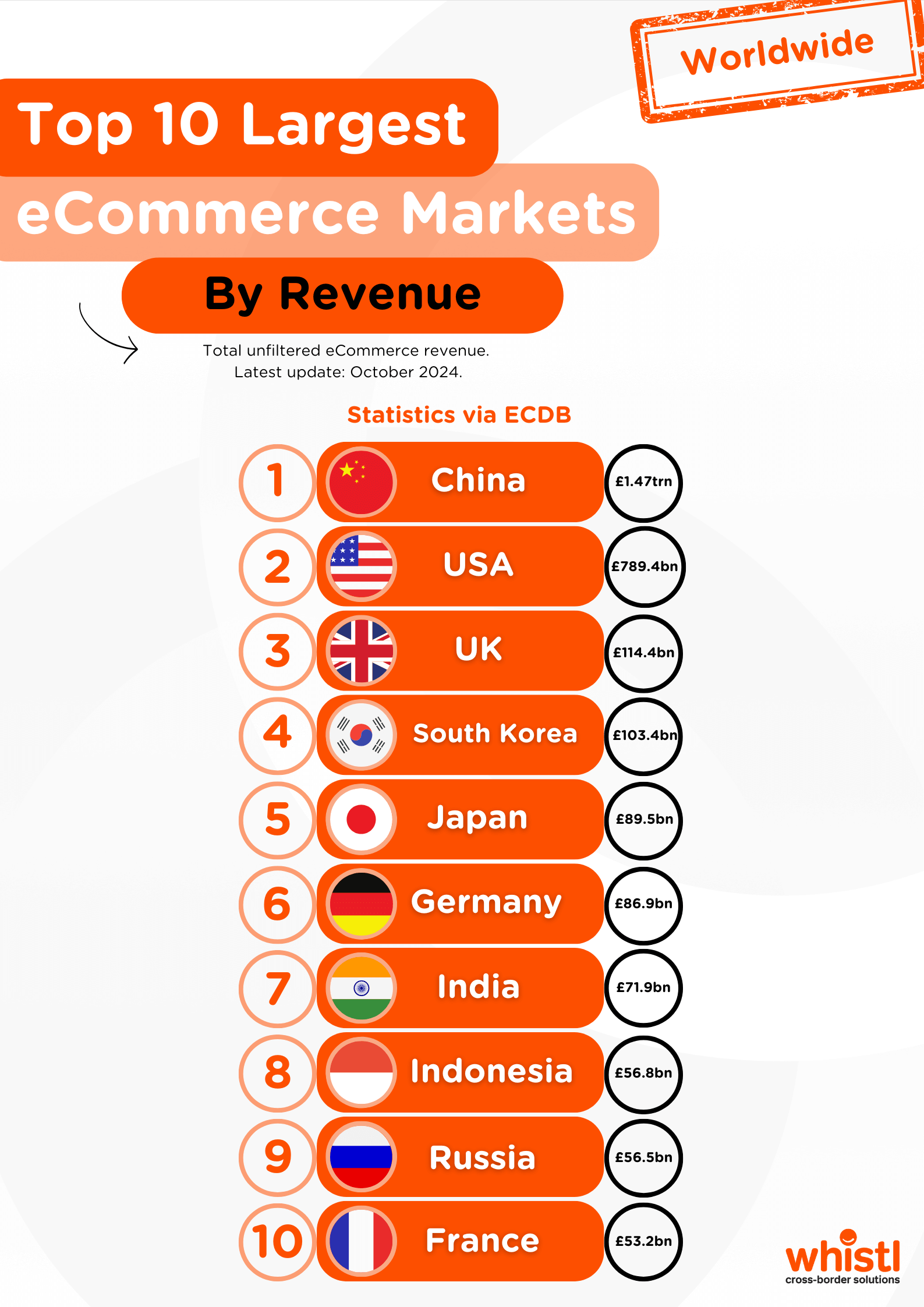
- China: The world's largest eCommerce market, led by giants such as Alibaba and JD.com. To put things into perspective, China’s eCommerce revenues are comparable to the GDP of Canada.
- United States: A mature market with a diverse range of online retailers and consumers. In the US, online retail makes up 27% of the retail market with this set to rise to 38% by 2028.
- United Kingdom: Europe’s largest and most sophisticated eCommerce market, fuelled by a strong tradition of online shopping. The UK eCommerce market is projected to grow at a compound annual growth rate (CAGR) of 6.4% between 2024 and 2028. Meanwhile, more and more UK retailers are finding their footing in the US.
- South Korea: Another Asian powerhouse known for its innovative eCommerce ecosystem. Whereas Fashion is the largest product category in the top three markets, Grocery is the dominant force in South Korea.
- Japan: A technologically advanced nation with a high penetration of internet and mobile devices. Grocery, Electronics, and Hobby and Leisure are the biggest product categories.
These growing markets in eCommerce have long benefited from factors such as large populations, high internet penetration, and well-developed logistics infrastructure. However, the playing field is levelling, and some unexpected contenders are emerging.
The Fastest-Growing eCommerce Markets in the World
Examining the global landscape by a percentage rise in eCommerce revenue growth uncovers the rising challengers.
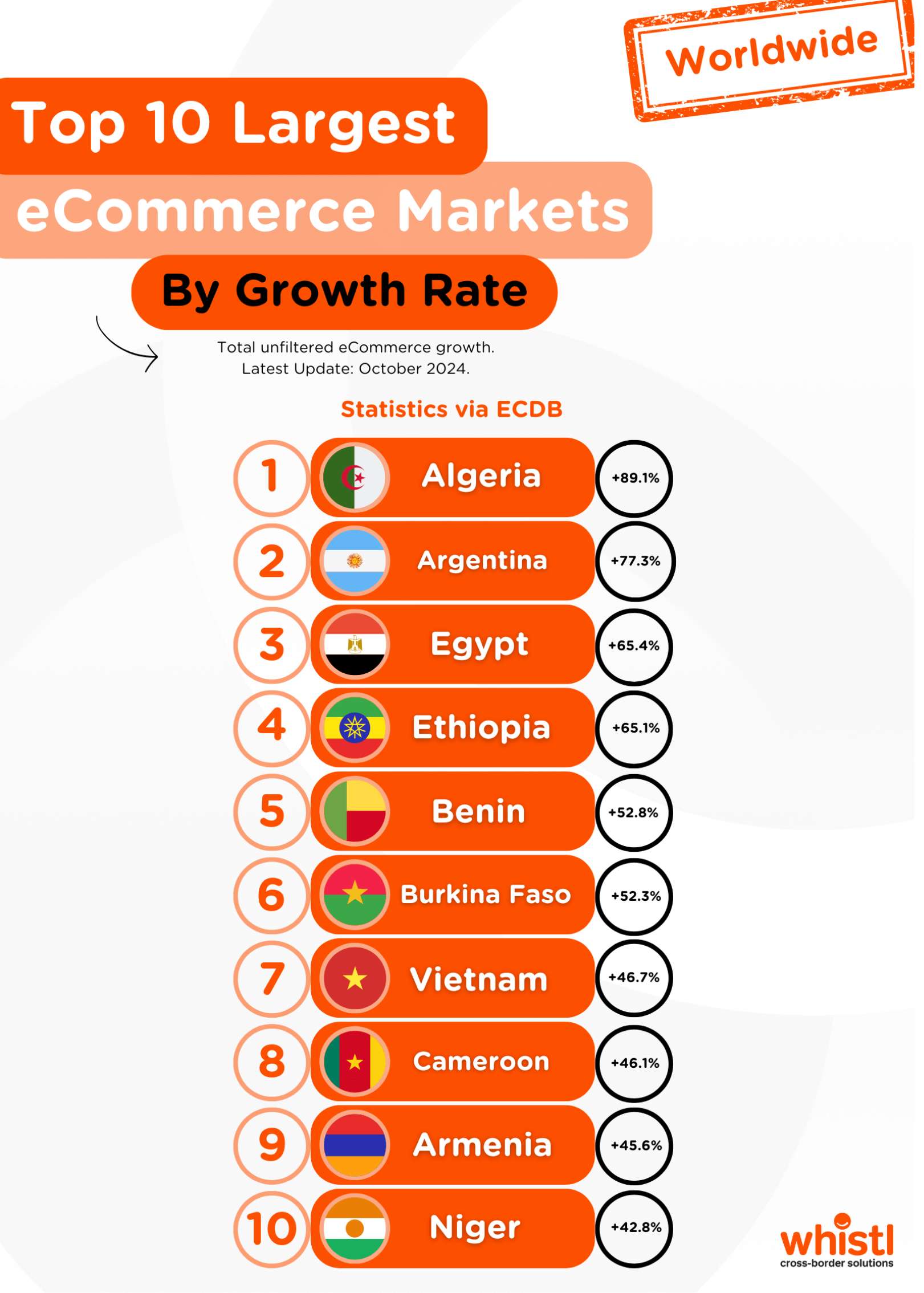
These are revealed in quarterly data from ECDB, which outlines the world’s highest-growth eCommerce markets.
Southeast Asia
A young, aspirational population is steering eCommerce growth in Vietnam. The local eCommerce market is currently worth £16.4bn and growing by 46.7%, supported by 39% of the population shopping online. This is a higher proportion of online shoppers than in countries such as South Africa and India.
Latin America
While the Brazilian eCommerce market (£29.9bn) dwarfs the size of its regional rivals, you cannot dismiss the exponential growth taking place across the Iguazu Falls.
In Argentina, eCommerce growth of 77.3% is way above any other country in South America. A sizeable 37% of online shoppers can boast a high income with Fashion their favourite category, accounting for over a third of the total eCommerce net sales at the top 100 stores.
Africa
While many of Africa’s high-growth markets have scaled from a low base, it’s still noteworthy to see the potential of the continent’s top eCommerce countries.
Algeria boasts the third-largest eCommerce revenues of any African country and an 89.1% growth rate. Egypt is the region’s powerhouse, with the Egyptian domains of Amazon and Carrefour among the leading online stores. Ethiopia (65.1% growth rate) is carrying the torch in East Africa, while Benin (52,8%), Burkina Faso (52.3%) and Cameroon (46.1%) are some of the fastest-growing eCommerce markets in West Africa.
Other Countries with High Global eCommerce Market Growth
Indonesia and India are predicted to leapfrog South Korea and Japan in the top five eCommerce markets by 2027-2028. Both are tracking at around a 20% eCommerce market growth rate and climbing.
Bangladesh has greatly enhanced internet access in recent years, making online payments significantly easier. This has resulted in the market becoming an eCommerce growth champion.
In the Americas, similar infrastructure upgrades and changing consumer behaviour are also laying the foundations for eCommerce success in Mexico and Peru. Electronics is the top product category in both countries.
How to Benefit from International eCommerce Industry Growth
Global eCommerce is growing rapidly with new and existing markets continuing to develop.
China, the United States and the United Kingdom will likely continue to drive the biggest revenues.
However, eCommerce retailers, stores, and brands should ensure they’re prepared to diversify and take advantage of opportunities elsewhere.
Top Tips to Improve Cross-Border Shipping Opportunities and eCommerce Industry Growth
Each market will have its own unique dynamics and require its own strategy. But by leveraging cross-border eCommerce expertise, you can successfully create new revenue streams and boost eCommerce market growth.
Here are some top eCommerce market growth tips to follow before you expand:
- Know your market
Establishing your product fit for the market you plan on entering is critical. Is there consumer demand, and can this be shown through previous purchase history? Do your research on the competition, size, and growth potential of your proposed market. And make sure you understand local regulations and requirements…
- Understand cross-border regulations
Taxation: Customers want to understand the full costs involved in buying a product from overseas. Make sure you budget for international expansion and provide clarity at the point of purchase to avoid a negative customer experience.
Duties: Stay on top of trade and cooperation agreements. These are reviewed and updated periodically to ensure that relevant customs duties are applied to imported or exported goods.
Commodity Codes: Commodity codes describe the product being sold and declared. Codes must be added as internationally recognised reference numbers to help identify customs duties, VAT, taxes, and any preferential rates. Find out more about these and other taxes in our international shipping FAQs.
Hidden Costs: Aside from cross-border taxes, customers may also have other charges added to the total cost of their goods. These are typically related to payment methods, payment processing, and banking networks.
Currencies: Giving consumers the option to pay for goods in their domestic currency is preferable as it helps them when comparing costs for products and with the transaction’s speed. Be efficient as rates do not stay static, and conversions can incur additional fees.
Learn More about eCommerce Market Growth with Parcelhub
So, have you set up an eCommerce store and want to reach more customers overseas? Unlock the potential of cross-border eCommerce with our smart and integrated solutions, such as international tracked delivery.
Get in touch to save time and reduce stress while we take care of the critical steps of the export journey. You’ll benefit from our cross-border expertise and top-tier knowledge of global eCommerce market growth, as well as the buying power of Parcelhub.
Share this article
You may also like...