In this article, we’ll cover the meaning of Delivery Duty Unpaid (DDU), so you can understand how it can benefit your business and if it’s the right solution for you.
What Is Delivery Duty Unpaid?
DDU in shipping refers to the process in which the seller assumes responsibility for delivering the goods to the buyer’s country but does not take responsibility for covering the costs of import duties, taxes, and customs clearance.
Browse our eCommerce Guide to Shipping from the UK into Europe for more information.
What Is DDU vs DDP vs DAP?
While the term DDU has since been replaced by Delivered at Place (DAP), it is still frequently utilised in transportation contracts. DDU changed to DAP to further clarify the responsibilities of the buyer and the seller. The seller is responsible for delivering goods to the destination, but import duties and clearance are explicitly the buyer's responsibility.
It can be easy to confuse DDU with other international shipping terms so we will break down the differences in responsibilities between the buyer and seller within these processes below.
| Service | Overview | Seller Responsibilities | Buyer Responsibilities |
|---|---|---|---|
| DDU/DAP | DDU, or Delivery Duty Unpaid, is the old term used to describe the process in which the seller delivers goods to the agreed-upon destination without covering the costs of import duties and taxes. DAP, Delivered at Place, has since replaced this to clarify the responsibilities. | ● Export packaging ● Loading at origin ● Export customs clearance ● Export duties/taxes ● Main carriage (international) ● Insurance (if agreed) ● Destination port/terminal charges ● Transport to a named destination | ● Import customs clearance ● Import duties and taxes |
| DDP | DDP, or Delivery Duty Paid, refers to a scenario where the seller takes responsibility for delivering goods to the buyer, covering all related costs, including import duties and taxes. | ● Export packaging ● Loading at origin ● Export customs clearance ● Export duties/taxes ● Main carriage (international) ● Insurance (if agreed) ● Destination port/terminal charges ● Transport to a named destination ● Import customs clearance ● Import duties and taxes | ● Nothing, except possibly unloading the goods |
Process of DDU in Shipping
Following Brexit, the UK is no longer part of a single market; therefore, international parcel delivery across the UK and EU borders is subject to customs duties and taxes.
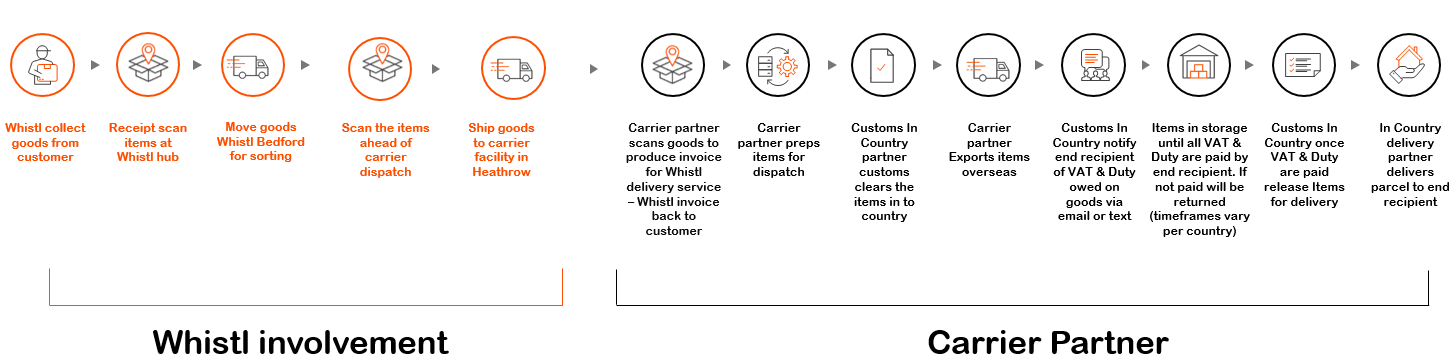
With Parcelhub’s Delivery Duty Unpaid service, your customer (the item recipient) is responsible for paying taxes and duties. The final recipient will be notified of the associated costs. A request to settle duties and taxes in full, in addition to the price of the parcel delivery service, is essential before the goods are cleared and delivered.
Parcelhub manages the whole delivery and customs process. The end customer is ultimately responsible for paying the duties before they can take final possession of their package. Below is a complete overview to ensure the most effective international delivery DDU solution for you and your customers.
Check out our international shipping FAQS for more information.
Pros and Cons of DDU in Shipping
Explore some of the previous cross-border opportunities and challenges of shipping with DDU below.
Benefits for the seller:
- DDU offers the seller less responsibility for import processes than DDP, meaning they avoid complicated and possibly unfamiliar customs regulations in the buyer’s country.
- As the buyer manages import clearance and duties, the seller can avoid unexpected costs or delays associated with these.
Benefits for the buyer:
- The buyer can enjoy greater control over import customs, which can increase efficiency if they are more familiar with local regulations than the seller.
- DDU is typically a lower total cost than DDP if better local customs brokerage or tax handling is secured.
- The pricing of DDU is usually more transparent because the duties and taxes are paid directly by the buyer.
Drawbacks for the seller:
- If responsibilities aren’t clearly defined at the start of the process, disputes about border costs could emerge, which is why DDU was updated to DAP.
- The DDU service isn’t as attractive as DDP, as buyers often want to avoid handling customs.
Drawbacks for the buyer:
- The buyer has to handle more of the process than in DDP, including customs clearance, import documentation, and local duties.
- The buyer may have to cover unforeseen charges if the duty and tax rates change.
- Goods deliveries may be subject to delays if the buyer is not prepared for the process or if there is a problem with the paperwork.
Leverage DDU in Shipping at Parcelhub
Now that you have a better understanding of the meaning of DDU in shipping, hopefully, you know whether this solution is right for your business.
As a UK business, navigating post-Brexit shipping regulations can be time-consuming and complex. It can also limit your reach and damage customer satisfaction if you are unsure how to continue delivering parcels to EU customers. With Parcelhub’s parcel export services, we will remove these obstacles, as you can rely on our EU delivery expertise and work closely with your dedicated account manager.
If you would like to learn more about what DDU is or receive a tailored quotation, please contact our team today. We will be more than happy to guide you through our process and answer any questions you may have about air freight, imports to the UK, the Import One-Stop-Shop, and other related topics.
Share this article
You may also like...