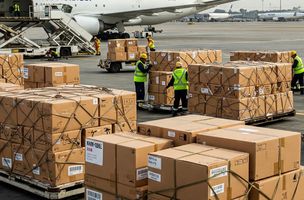
If you’re here to learn what the Import One-Stop Shop (IOSS) is, you’re on the right page. Read on to learn about how the scheme works, what an IOSS number is, and the benefits of the scheme. We also compare different international parcel delivery processes to ensure you can pick the most suitable export service.
- What Is the IOSS?
- IOSS Registration and Compliance Requirements for Non-EU Sellers
- Options for Transporting Goods to the EU from the UK
- Required Fees for Shipping Goods in the EU
- Calculating the Value of the Goods
- Choose Parcelhub for Your IOSS Solutions
What Is the IOSS?
The EU’s Import One-Stop Shop, or IOSS, allows eCommerce sellers to register with just one of the EU tax authorities and submit one monthly IOSS VAT return. This streamlined process ensures that VAT is correctly paid across the other EU tax authorities where customers are located.
The IOSS was created to facilitate and simplify the declaration and payment of VAT for sellers making distance sales of imported goods to buyers in the EU, where the value of those goods does not exceed €150.
If the seller is not registered in the IOSS, the buyer must pay the VAT and, typically, a customs clearance fee charged by the transporter when the goods are imported into Europe.
What Is an IOSS Number?
An IOSS number is a unique identification number used for declaring in the One-Stop Shop scheme. It enables individuals to pay tax on goods they sell within the EU under a monthly VAT return. This streamlines the process of international shipping by reducing the amount of paperwork – with an IOSS number, you don’t have to fill out forms in multiple EU countries.
How Do You Get an IOSS Number?
If you’re not based in the EU, you may be required to register for IOSS through an EU intermediary. The intermediary will register on your behalf and take responsibility for VAT reporting and payment. Once you are registered, you will receive an IOSS identification number, which you will then provide to your shipping partner. Once it has been issued, you can use your IOSS number immediately.
What If I Don’t Receive My IOSS Number?
On the assumption you have provided all the information in a timely manner, and dependent on the tax authorities' processing times, we expect this to take five to seven weeks from the time the registration application is submitted.
If you have not received your IOSS number after the predicted timeline and it is not in your spam email folder, contact your intermediary for more information. Your intermediary is responsible for following up with the tax authority.
IOSS Registration and Compliance Requirements for Non-EU Sellers
If you are a non-EU seller, take note of the following requirements:
- Non-EU sellers (including those in the UK) must appoint an intermediary to register for IOSS.
- Upon registration for IOSS, the tax authorities in the EU member state where the registration is made will issue an IOSS VAT registration number.
- Once registered for IOSS, the seller will display the price of the goods and the VAT amount due on the respective order when it is placed, allowing the customer to pay the total amount, including any applicable VAT, at the point of sale. The VAT rate applicable will be the VAT rate in the EU member state to which the goods are delivered.
- The IOSS number should then be provided to Parcelhub to avoid charging VAT at the point of importation.
- IOSS returns are submitted monthly to the member state of registration for all goods supplied to final consumers across all EU member states.
- The VAT payment deadline is the end of the month following the month of reporting.
- For non-EU sellers registered through an intermediary, the relevant information may need to be provided to the intermediary to fulfil the obligations of filing the IOSS returns.
Options for Transporting Goods to the EU from the UK
Several options are available for eCommerce sellers sending parcels to the EU, including International Delivery Duty Paid (DDP), International Delivery Duty Unpaid (DDU), IOSS (self-registered or through a marketplace), and assisted IOSS.
We've compiled the summary below to help you understand how IOSS works, cross-border benefits and challenges, and which option best suits your business and parcel delivery volumes.
Delivered Duties Unpaid (DDU)
Overview:
UK sellers do not require their customers to pay tax. The EU recipient is contacted in the country and pays VAT owed before receiving the item.
Process:
No action needed.
Benefits:
- A simple option that requires no changes to the current process.
- It can help you ensure costs appear low at checkout.
Challenges:
- Unexpected costs for your EU recipient (VAT and handling fee).
- Customers can refuse to pay and have the item returned, which can be costly and lead to a poor customer experience.
IOSS - Sender Self-Registration
Overview:
The UK seller registers for VAT themselves via an intermediary, collects VAT, and completes monthly tax returns.
Process:
- Integrate a landed cost calculator or a similar tool.
- Register for IOSS using a tax agent in one EU country.
- Register and get an IOSS number.
- Provide the IOSS number to the parcel carrier in pre-advice.
- Account for VAT and complete monthly returns.
Benefits:
- Saves on third-party costs as it often uses in-house tax expertise or resources where available.
- Better customer experience.
Challenges:
- Specialised understanding and time are required to manage returns, including handling enquiries with tax authorities, choosing where to register and file, and deciding on an intermediary.
- Risk of issues when completing returns.
IOSS - Selling Via a Marketplace
Overview:
The UK seller sells through a marketplace that collects and pays VAT on items valued at €150 or below.
Process:
- Register to sell with a marketplace.
- Place your goods on their website.
- They may (but won’t necessarily) take care of VAT obligations.
Benefits:
- The Marketplace takes care of VAT (for products up to €150) and provides the IOSS number.
- Offers broader market access.
Challenges:
- Reliance on the marketplace.
- Fees are taken from each sale (10% plus).
- Reduced control and brand recognition.
- Doesn’t cover products over €150.
Assisted IOSS Solutions
Overview:
UK seller uses trusted partners to:
- Provide support in registering and completing tax returns.
- Completely take care of EU VAT compliance instead of the seller, simplifying the process for collecting and paying VAT on items with a value up to €150.
Process:
Pay a fee to a third party to either:
- Support you in registering and filing IOSS VAT returns for a fee.
- Take care of VAT at the point of sale and pay VAT obligations under the partner’s IOSS number.
Benefits:
- Better customer experience – the VAT due is paid up-front.
- Peace of mind if you want to register yourself for IOSS.
- Simplifies the process of filing and registering for IOSS, helping with compliance.
Challenges:
- Requirement to provide the right data to complete VAT returns, unless the ‘per parcel model’ is used.
- The ‘per parcel model’ might be more costly.
You need to consider the volume of parcels you send and whether you have the systems and processes in place to provide the right data for your own IOSS returns.
Delivered Duties Paid (DDP)
Overview:
Delivered Duties Paid (DDP) allows UK sellers to collect and pay VAT (and customs duty for items above €150) on goods that the customer would otherwise pay before receiving their parcel.
Process:
- Integrate a landed cost calculator.
- Register for the DDP service and pay VAT/Duty on behalf of your EU customer upfront.
- The EU customer receives their product without interruption before delivery.
Benefits:
- Useful if you have small but irregular volumes of sales or goods over €150.
- Maintains your customer experience.
Challenges:
- Need to increase prices to cover the cost of VAT and Duty.
- It can be cost-ineffective for low-value parcels or a larger number of parcels.
- It can be difficult to obtain a VAT refund when goods are returned.
Required Fees for Shipping Goods in the EU
| Goods/Total Basket Value Under €150 | Goods/Total Basket Value Over €150 |
|---|---|
| • VAT | • VAT |
| • Formal clearance | • Formal clearance |
| • Customs clearance fee | • Customs clearance fee |
| • IOSS can apply | • Customs duties |
| • IOSS can NOT apply |
Calculating the Value of the Goods
The value of the goods is also referred to as the intrinsic value. The value does NOT include transport or insurance costs, but VAT is applicable on these costs.
| Receipt A | Receipt B | Receipt C |
|---|---|---|
| Value of good: €100 | Value of good: €100 | Value of good: €160 |
| Transport costs: €30 | Transport costs: €30 | |
| Insurance costs: €30 | ||
| VAT (20%): €20 | VAT (20%): €32 | VAT (20%): €38 |
| Total: €120 | Total: €192 | Total: €228 |
| IOSS can apply, as the intrinsic value of the good is under €150. | IOSS can apply, as the intrinsic value of the good is under €150. | IOSS can NOT apply, as the intrinsic value of the good is over €150. |
| The VAT rate is applied to the value of the goods PLUS the transport and insurance costs. | The VAT rate is applied to the value of the goods PLUS the transport and insurance costs. |
Choose Parcelhub for Your IOSS Solutions
Hopefully, you now have a better understanding of what IOSS is and how it simplifies VAT compliance for goods sold into the EU. Understanding VAT obligations can be a little tricky, but with the right partner, you can streamline the process.
Parcelhub’s international shipping services, which include managing your Import One-Stop Shop needs, come with tracking options, a dedicated account manager, and a single-contract system for streamlined communication and reduced administrative time.
Reach out to our team today to understand how we can support your company’s international shipping and tax compliance needs. We can also help you with freight transportation and imports to the UK.
Enquire about the IOSS scheme.
Helpful Resources on the IOSS Scheme
- Download our IOSS FAQs
- Browse our international shipping FAQs
- Explore the EU’s guidance on the Import One-Stop Shop
- Read more about the OSS Union Scheme
- Read the UK Government’s published information on EU VAT changes
Share this article
You may also like...